


SEPTEMBER 30, 2026
Megaprojects: A Cross-Sector Industrial Capex Cycle
ClearBridge Investments believes an industrial capex cycle for LNG infrastructure, semiconductors, manufacturing reshoring and grid modernization remains in its early stages.
최근 SNS를 통해 프랭클린템플턴을 사칭하여 코인 사기를 치는 사례가 발생하고 있습니다.
당사 및 임직원은 웹사이트, 전화, 이메일, 우편 및 소셜미디어(오픈톡, 리딩방 등)를 통해 투자상담이나 금융거래를 권유하지 않습니다.
투자자 여러분께서는 이러한 사이버 범죄 피해를 입지 않도록 각별히 주의하시기 바라며, 의심스러운 사항이나 문의사항이 있으시면 아래에 기재된 피해 신고 센터로 연락하시기 바랍니다
• 무등록 투자자문·일임업 관련
금융감독원 유사투자자문 피해신고(유사투자자문업자의 경우)
1. 금감원 홈페이지(www.fss.or.kr) ➤ 「민원·신고」 ➤ 「불법금융신고센터」 ➤ 「유사투자자문피해신고」
2. 전화 신고: (02) 3415-7692, 7632, 7633
•금융감독원 신고센터 전화 1332
•경찰청 사이버범죄 신고시스템(ECRM) 또는 가까운 경찰서(112)
링크 접속 (https://ecrm.police.go.kr/minwon/main) ➤ 「제보하기」

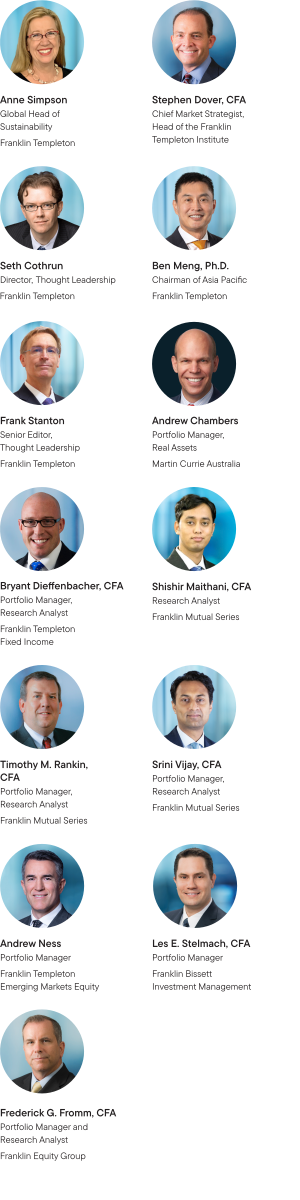
CONTRIBUTORS

Global Head of Sustainability, Franklin Templeton
New technologies are accelerating the renewable energy transition while reducing environmental impacts. The renewable energy sources of today and the future require new and smarter technologies as well as the rapid creation of new infrastructure. We hope you find the perspectives from across our specialist investment managers insightful, thought provoking, and even encouraging.
Scroll to view all chapters.
As you read this, be it on screen or old-fashioned paper, sitting down with a cup of tea, hot from the kettle, with perhaps a slice of cake or piece of fruit, you are in the midst of the global energy transformation. Energy powers everything in the room in which you sit and is critical to the production of most of the things that fill that room.
The source of energy—its reliability, affordability and impact on climate change—puts us at the heart of complex and urgent challenges. The first industrial revolution brought prosperity to many as we drew upon an ancient store of carbon laid below ground over 300 million years ago. The trees and other plants that covered the earth for eons were buried under rock at great pressure to form coal, oil and gas. Happily, in the evolutionary arc of change, this was before microbes came along, so this precious store of organic material did not decompose. It was transformed under pressure, and we stumbled across it in an extraordinarily recent stage in human history.
We started tapping into those sources of energy just 300 years ago, and now around 80% of our world energy supply is taken from that extraordinary Carboniferous Period, well named for the familiar carbon element.
Although this may be an ancient source, we’ve transformed our world in a short time through its use. Now there is a mighty task ahead. Many scientists tell us, and world governments agree, that we need to shift to low and net-zero carbon in a little less than 30 years.
Arguably, this is currently humanity’s greatest challenge. Meeting this will likely require all sides to pull together. The invisible hand of the market can play its part clasped with the visible hand of policy. Both are informed by, and reliant upon, innovation to bring forward the technology we need. Civil societies will buttress both the policy measures of their governments and also provide the bulk of the finance needed as they channel their savings to pay for vitally important financial goals.
It is a complex, global partnership at work, in which investors have a critical role given the capital needed to fund this transition. It also provides us with a tremendous opportunity. This opportunity is financial, as meeting the demands of the energy transition brings new potential for generating the risk-adjusted returns that sustainable investment demands. As a fiduciary, we must make decisions that have a foundation in economics and that seek to ensure the best outcomes for our clients.
This new collection of papers from our Franklin Templeton Institute will help us navigate this transition in the global financial markets that is transforming our understanding of how we ensure those risk-adjusted returns are generated. It’s important to point out this piece represents a cross section of our specialist investment teams, all of which have autonomous investment processes and decision-making—this breadth of investment perspectives is one of the strengths of Franklin Templeton. We write this with humility, as we all are navigating quickly changing environments. As such, we can’t cover every aspect of energy transition, or even cover each technology or proposed solution at stake fully. Without hesitation, we face headwinds, but we cannot turn around—we choose to tack into the wind.
We know this requires stewardship of not only financial but also natural and human capital. In simple terms, it reflects the potential for reframing our strategies around people, planet and prosperity. This approach is set out with clarity in the preamble to the 2015 Paris Agreement, which provides the Climate Action framework and action plans of the United Nations’ Sustainable Development Goals, agreed to the following spring by 196 governments. Those signatures to the treaty—and it important to note the Paris Agreement is an international treaty—provide the license to operate.
I hope your tea has not gone cold as you read this. Put the kettle back on and settle in to reading how finance is working to be part of the solution across asset classes in our global portfolios.
We look forward to discussing these pieces with you, and welcome your feedback.

Anne Simpson
Global Head of Sustainability
Franklin Templeton
All investments involve risks, including possible loss of principal.
The views expressed are those of the investment manager and the comments, opinions and analyses are rendered as at publication date and may change without notice.
Fixed income securities involve interest rate, credit, inflation and reinvestment risks, and possible loss of principal. As interest rates rise, the value of fixed income securities falls.
Equity securities are subject to price fluctuation and possible loss of principal.
Investing in the natural resources sector involves special risks, including increased susceptibility to adverse economic and regulatory developments affecting the sector—prices of such securities can be volatile, particularly over the short term.
Small- and mid-cap stocks involve greater risks and volatility than large-cap stocks.
International investments are subject to special risks, including currency fluctuations and social, economic and political uncertainties, which could increase volatility. These risks are magnified in emerging markets.
Sovereign debt securities are subject to various risks in addition to those relating to debt securities and foreign securities generally, including, but not limited to, the risk that a governmental entity may be unwilling or unable to pay interest and repay principal on its sovereign debt.
Investments in fast-growing industries like the technology and health care sectors (which have historically been volatile) could result in increased price fluctuation, especially over the short term, due to the rapid pace of product change and development and changes in government regulation of companies emphasizing scientific or technological advancement.
Real estate securities involve special risks, such as declines in the value of real estate and increased susceptibility to adverse economic or regulatory developments affecting the sector.
Any companies and/or case studies referenced herein are used solely for illustrative purposes; any investment may or may not be currently held by any portfolio advised by Franklin Templeton. The information provided is not a recommendation or individual investment advice for any particular security, strategy, or investment product and is not an indication of the trading intent of any Franklin Templeton managed portfolio.
Franklin Templeton and our Specialist Investment Managers have certain environmental, sustainability and governance (ESG) goals or capabilities; however, not all strategies are managed to “ESG” oriented objectives.
This material is provided for general informational purposes only and should not be considered individualized investment advice, a recommendation or a solicitation to adopt any investment strategy. It does not constitute legal or tax advice. Franklin Templeton accepts no liability for losses arising from use of this material.
The views expressed are those of the investment manager as of the publication date and may change without notice. These opinions and analyses are based on certain assumptions, including market conditions that may change. They may differ from those of other portfolio managers or from the firm as a whole.
This material is not intended to provide a complete analysis of all material facts regarding any country, region or market. No assurance can be given that any forecast, projection or prediction regarding economies or financial markets will be realized. References to specific securities are for illustrative purposes only and should not be interpreted as recommendations or a solicitation to buy, sell, or hold any security.
Any research or analysis in this material has been prepared by Franklin Templeton for its own purposes and is provided incidentally. While the information included is believed to be reliable, its accuracy and completeness cannot be guaranteed, and it is subject to change without notice.
Past performance does not guarantee future results, or any profit or gain. All investments involve risks, including possible loss of principal.
Franklin Templeton offers environmental, social and governance (ESG) capabilities, though not all strategies or products incorporate ESG as part of the investment process.
Investment strategies and services may not be available in all jurisdictions. Please consult your financial professional or Franklin Templeton contact for further information.
Brazil: Issued by Franklin Templeton Brasil Ltda. Canada: Issued by Franklin Templeton Investments Corp. Franklin Templeton and Franklin Templeton Canada are business names used by Franklin Templeton Investments Corp. Offshore Americas: In the United States, this publication is made available by Franklin Templeton. United States: Issued by Franklin Templeton. Investments are not FDIC insured; may lose value; and are not bank guaranteed.
Europe: Issued by Franklin Templeton International Services S.à r.l., 8A, rue Albert Borschette, L-1246 Luxembourg. Poland: Issued by Templeton Asset Management (Poland) TFI S.A.; Rondo ONZ 1; 00-124 Warsaw. Saudi Arabia: Issued by Franklin Templeton Financial Company, KAFD, Building 3.09, Office No. 8018, Level 8, Saudi Arabia. Regulated by CMA. License no. 23265-22. South Africa: Issued by Franklin Templeton Investments SA (PTY) Limited, which is authorised by the FSCA as a Financial Service Provider (No.44475). Switzerland: Issued by Franklin Templeton Switzerland Ltd, Talstrasse 41, CH-8001 Zurich. Middle East & Africa (ex South Africa): Issued by Franklin Templeton Investments (ME) Limited, which is regulated by the Dubai Financial Services Authority. Address: Franklin Templeton, The Gate, East Wing, Level 2, Dubai International Financial Centre, P.O. Box 506613, Dubai, U.A.E. Tel: +971(04) 428 4100. United Kingdom: Issued by Franklin Templeton Investment Management Limited (FTIML), registered office: Cannon Place, 78 Cannon Street, London EC4N 6HL.
Australia: Issued by Franklin Templeton Australia Limited (ABN 76 004 835 849) (Australian Financial Services License Holder No. 240827), Level 47, 120 Collins Street, Melbourne, Victoria 3000. Hong Kong: Issued by Franklin Templeton Investments (Asia) Limited. Japan: Issued by Franklin Templeton Japan Co., Ltd. South Korea: Issued by Franklin Templeton Investment Advisors Korea Co., Ltd. Malaysia: Issued by Franklin Templeton Asset Management (Malaysia) Sdn. Bhd. & Franklin Templeton GSC Asset Management Sdn. Bhd. Singapore: Issued by Templeton Asset Management Ltd. (UEN) 199205211E.
Access your local website at https://www.franklintempleton.com/corporate/all-sites.
CFA® and Chartered Financial Analyst® are trademarks owned by CFA Institute.
Copyright © 2026 Franklin Templeton. All rights reserved.


