

CONTRIBUTORS
Brian S. Freiwald, CFA
Portfolio Manager
United States
Reshoring and nearshoring are key trends for investors in global markets. As geopolitical tensions escalate and more businesses shift operations away from China, investors are considering the impacts of deglobalization. For many businesses and regions, we believe it could drive meaningful growth, with Mexico as one of the biggest beneficiaries.
In our view, Mexico stands to benefit from both reshoring — businesses moving their manufacturing back to their domestic markets, and nearshoring — businesses moving manufacturing to regions that are closer to their headquarters.
Executives are planning to increase investments in Mexico
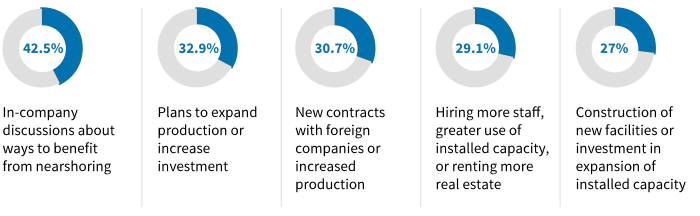
Nearshoring to Mexico is still in its early phases, but we continue to see positive developments beyond already announced investment and expansion plans. In a survey of companies operating in Mexico, the Central Bank of Mexico found that a significant percentage of corporate executives are planning increased levels of investment. This includes expanding production, hiring more staff, and renting more real estate as a result of nearshoring opportunities.
The impact of nearshoring on business plans
Corporate executives in Mexico surveyed on impact (% who responded affirmatively)
Source: Banco de Mexico, with data from the Programme of Surveys to Corporate Executives.
Observations from our research
Through our travel, meetings, and research, we have observed nearshoring trends and their potential to drive further economic growth in Mexico.
- On our recent trip to Taiwan, we confirmed that Taiwanese companies — ranging from AI server assemblers to even curtain makers — have a strong desire to accelerate their expansion plans in Mexico.
- Conversations with IT services companies from India, Latin America, and the U.S. confirm incremental investments toward nearshore capabilities, as proximity, better time zone compatibility, and skilled talent bases drive client demand.
- One of the largest freight forwarders told us it is seeing a big increase in demand from clients to use Mexico as a final assembly base.
Mexico outpaces China in exports to the U.S.
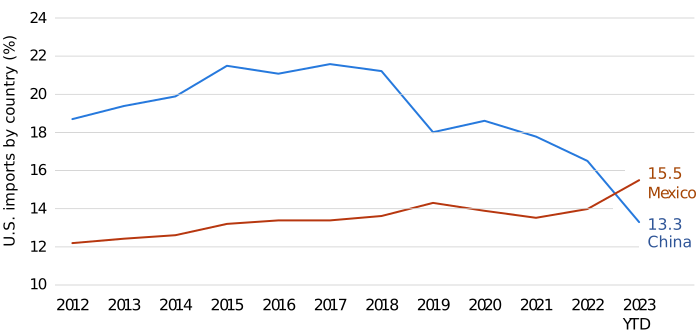
Mexico is experiencing a surge in exports due in large part to nearshoring trends. In early 2023, for the first time in decades, Mexico overtook China as a source of exports to the U.S.
Mexico overtakes China as leading exporter to the United States
Source: JP Morgan.
As a result of nearshoring trends, minimum wage hikes in Mexico have been consistent, with an additional increase of 15% to 20% expected in 2024. Although this can put pressure on corporate profits, it bolsters the spending power of consumers. Also, inflation in Mexico is moderating from elevated levels. Benchmark rates have likely peaked, but Banxico, Mexico’s central bank, has indicated a cut is not likely any time soon, as inflation is still above its target range.
Year to date, Mexico has been one of the best-performing markets in the world, due in part to the strong appreciation of the Mexican peso. We believe there is room for further outperformance, driven by upward earnings estimate revisions and compelling valuations.
Positive outlook for EM equities overall
While we are bullish on Mexico’s economic outlook and growth potential driven by nearshoring, we are also bullish in our outlook for emerging market stocks overall. In addition to Mexico, we are particularly focused on opportunities in India and Indonesia, which are also beneficiaries as businesses look to expand operations outside of China. We believe stock prices follow earnings over the long run. Therefore, EM stocks may be poised for compelling growth, especially over the next three to five years.
WHAT ARE THE RISKS?
All investments involve risks, including possible loss of principal.
Equity securities are subject to price fluctuation and possible loss of principal.
International investments are subject to special risks, including currency fluctuations and social, economic and political uncertainties, which could increase volatility. These risks are magnified in emerging markets. Investments in companies in a specific country or region may experience greater volatility than those that are more broadly diversified geographically.
The government’s participation in the economy is still high and, therefore, investments in China will be subject to larger regulatory risk levels compared to many other countries.
There are special risks associated with investments in China, Hong Kong and Taiwan, including less liquidity, expropriation, confiscatory taxation, international trade tensions, nationalization, and exchange control regulations and rapid inflation, all of which can negatively impact the fund. Investments in Taiwan could be adversely affected by its political and economic relationship with China.
Any companies and/or case studies referenced herein are used solely for illustrative purposes; any investment may or may not be currently held by any portfolio advised by Franklin Templeton. The information provided is not a recommendation or individual investment advice for any particular security, strategy, or investment product and is not an indication of the trading intent of any Franklin Templeton managed portfolio.