

CONTRIBUTORS

Stephen Dover, CFA
Chief Market Strategist
Head of Franklin Templeton Institute

Lawrence Hatheway
Global Investment Strategist
Franklin Templeton Institute
As 2025 draws to a close, investors are looking forward to opportunities in 2026. The Franklin Templeton Institute’s Global Investment Outlook highlights our views for three key themes that we’re confident will shape the year ahead: Broadening, Steepening, and Weakening.
Broadening beyond US exceptionalism
For more than a decade, US exceptionalism has dominated global equity, fixed income and alternative investment returns. Since the global financial crisis, US-based investments have consistently delivered superior risk-adjusted returns—driven by strong corporate profitability, superior liquidity, and breadth of investment instruments. In recent years, US leadership has been centered around the rising fortunes of mega-capitalization technology stocks.
But we believe a turning point has arrived. While US innovation in technology remains unparalleled, investment opportunities are expanding and we believe they will be more globally diversified.
Several factors underpin this shift. Within the US equity market, small cap, industrial, and financial stocks appear poised for revival. These interest-sensitive sectors should benefit from lower financing costs and a steeper yield curve as the Federal Reserve (Fed) and other central banks continue to ease monetary policy next year. Financials stand to gain from improving net interest margin and expanding capital market issuance.
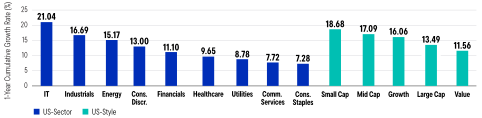
Exhibit 1: Expected Earnings Growth by US Sector and Style
As of September 29, 2025
Source: FactSet. Analysis by FT Institute. S&P indexes are used. Indexes are unmanaged and one cannot directly invest in them. They do not include fees, expenses or sales charges.
Key takeaway: Throughout 2025, mega-cap technology stocks have enjoyed significant earnings and price momentum, pushing their valuations higher along the way. Yet, other market segments—including various sectors, investment styles, and market capitalizations—are also exhibiting strong signs of earnings growth, suggesting to us that investors might find more attractive opportunities by diversifying their investment scope.
Outside the United States, the landscape also looks more promising to us. In our view, earnings growth in many emerging market (EM) countries will probably exceed that of the United States, driven by synchronized global monetary easing and currency translation gains. Even Europe, long mired in slow growth, appears slated to reaccelerate thanks to combined monetary and fiscal stimulus. The result could be a cyclical recovery spanning various regions, offering investors greater geographic opportunity and diversification following a decade of US dominance.
Broadening extends to fixed income. As policy rates fall, the appeal of holding cash will likely recede. Many investors will reallocate short-term allocations to longer-duration bonds and credit—public and private. EM debt appears to deliver a second consecutive year of solid returns, in our view. A contributing factor will be a weaker US dollar. But even non-dollar investors should benefit, given falling hedging costs as the Fed eases. Finally, lower EM inflation would pave the way for further rate cuts, reinforcing EM bond performance.
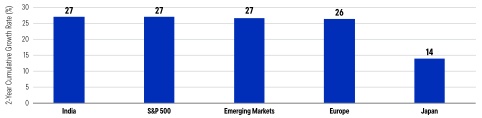
Exhibit 2: Projected Earnings Growth by Region
As of October 1, 2025
Source: FactSet. Analysis by FT Institute. MSCI indexes used for international countries, in USD. US represented by the S&P 500. Indexes are unmanaged and one cannot directly invest in them. They do not include fees, expenses or sales charge. There is no assurance that any estimate, forecast or projection will be realized.
Key takeaway: We’re seeing a shift away from clear US market leadership. For the first time in years, corporate earnings from international and EM companies are on par with those of US companies. We believe this trend highlights a compelling reason for investors to diversify globally and lessen their reliance on US-centric portfolios.
Steeper yield curves ahead
Our second major theme for 2026 is steepening. After nearly a year’s pause, the Fed resumed rate cuts in late 2025 and we expect the Fed to ease further in 2026 as we anticipate US inflation to peak and then resume declining. Other central banks, particularly in EM economies, have been moving in the same direction, while the European Central Bank (ECB) has eased aggressively over the past 18 months.
Meanwhile, strong corporate and government borrowing demand will likely keep longer-term yields elevated. The explosive growth of investment in artificial intelligence and related infrastructure is creating unprecedented demand for capital. And public borrowing appears set to rise sharply across the United States, Europe and China, as governments fund fiscal expansion and industrial policy. Together, these trends suggest long-term yields may not fall as quickly as short rates, keeping yield curves steep.
The result would be a steeper yield curve, where short-term rates fall relative to long-term rates, which has profound investment implications. Yield-curve steepening signals confidence in future growth, and it is particularly supportive for more cyclically sensitive sectors and styles. It also forces investors sitting on large cash holdings to seek opportunity elsewhere or otherwise accept lower prospective cash returns.
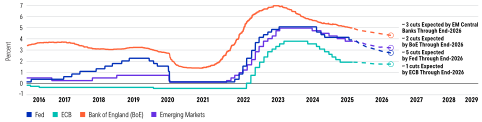
Exhibit 3: Central Banks’ Policy Rates: Past, Present and Future Forecasts
As of October 22, 2025
Sources: ECB, ICE, BoE, Fed, CME Group, Bloomberg, Macrobond. Analysis by Franklin Templeton Institute. Implied rates for the Fed, ECB, and BoE are based on Fed Funds futures, €STR futures, and SONIA futures, respectively. Policy rate for Emerging Markets represents a simple average across 16 emerging market countries, based on Bloomberg surveys: Mexico, Brazil, Indonesia, India, China, Taiwan, South Korea, South Africa, Poland, Malaysia, Thailand, the Czech Republic, Hungary, Chile, Peru, and Colombia. Expectations are based on consensus economic forecasts sourced from Bloomberg. There is no assurance that any estimate, forecast or projection will be realized.
Key takeaway: We expect yield curves to steepen in 2026 as central banks cut short term rates. This creates a new environment that makes longer-duration fixed income relatively more attractive than before and provides a tailwind for rate-sensitive public equities and private assets.
Specifically, we believe extending into duration and credit investments offers attractive income potential. Steeper curves will also likely spur flows into alternative assets such as private credit and real estate. The message is clear to us: the era of “cash is king” may be fading, replaced by a renewed search for yield across a wider investment universe.
In short, the steepening of yield curves also reinforces our broadening theme.
Weakening: Ripple effects from the US dollar’s retreat
Our third cyclical theme for 2026 is weakening—specifically, the weakening of the US dollar. After years of strength, the dollar fell roughly 10% in 2025 and is likely to decline next year as well. Several forces are at play: ongoing Fed rate cuts, moderating US growth, and shifting global capital flows toward higher-yielding and undervalued non-US assets.
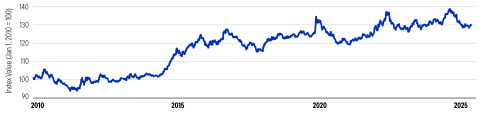
Exhibit 4: Nominal US Dollar Index Performance
As of October 17, 2025
Sources: Federal Reserve, Bloomberg, Macrobond. Index shown: US Fed Trade-Weighted Nominal Broad Dollar Index. Indexes are unmanaged and one cannot directly invest in them. They do not include fees, expenses or sales charges. Past performance is not an indicator or a guarantee of future results.
Key takeaway: After years of broad strength, the US dollar has been losing momentum and appears to be signaling a shift toward a weaker dollar environment ahead. This transition supports non-US assets, enhances the appeal of EM-local currency debt, and improves global diversification opportunities as hedging costs decline.
A softer dollar has far-reaching consequences. For EM economies, it is a clear tailwind. Local-currency debt becomes more attractive as domestic inflation pressures ease and EM central banks cut rates. Equity valuations in EM countries should also benefit. In Europe, a weaker dollar may push inflation below the ECB’s target, which could potentially prompt further monetary easing that supports eurozone equities and credit.
Investors in non-dollar regions—such as Europe or Japan—stand to gain as US short-term interest rates decline, lowering hedging costs and making global diversification more rewarding. Commodity markets also historically thrived in a weaker-dollar environment, with assets like gold and industrial metals gaining in price. Even digital currencies could appreciate relative to the dollar.
Oil may be the exception. Despite geopolitical tensions, abundant supply and the possibility of renewed Russian exports should cap crude prices. Still, for most asset classes, dollar weakening amplifies the year’s broader themes of diversification and opportunity.
Conclusion
Taken together, the forces of broadening, steepening, and weakening paint a picture of a much different global investment landscape in 2026 than in recent years. We believe the year ahead marks the onset of transition from US investment exceptionalism to a broader, multi-regional recovery; from cash returns to more rewarding opportunities in longer-duration credit and EM debt; and from US-centric dollar strength to global diversification.
Our takeaway as investors is simple and profound: Be prepared to adapt to change, diversify broadly, and challenge assumptions of the past.
WHAT ARE THE RISKS?
All investments involve risks, including possible loss of principal.
The allocation of assets among different strategies, asset classes and investments may not prove beneficial or produce desired results.
Equity securities are subject to price fluctuation and possible loss of principal. Small- and mid-cap stocks involve greater risks and volatility than large-cap stocks.
Fixed income securities involve interest rate, credit, inflation and reinvestment risks, and possible loss of principal. As interest rates rise, the value of fixed income securities falls. Changes in the credit rating of a bond, or in the credit rating or financial strength of a bond’s issuer, insurer or guarantor, may affect the bond’s value. Low-rated, high-yield bonds are subject to greater price volatility, illiquidity and possibility of default.
Sovereign debt securities are subject to various risks in addition to those relating to debt securities and foreign securities generally, including, but not limited to, the risk that a governmental entity may be unwilling or unable to pay interest and repay principal on its sovereign debt.
Investments in many alternative investment strategies are complex and speculative, entail significant risk and should not be considered a complete investment program. Depending on the product invested in, an investment in alternative strategies may provide for only limited liquidity and is suitable only for persons who can afford to lose the entire amount of their investment.
Currency management strategies could result in losses to the fund if currencies do not perform as expected.
Investing in privately held companies presents certain challenges and involve incremental risks as opposed to investments in public companies, such as dealing with the lack of available information about these companies as well as their general lack of liquidity.
International investments are subject to special risks, including currency fluctuations and social, economic and political uncertainties, which could increase volatility. These risks are magnified in emerging markets.
WF: 7853264