

CONTRIBUTORS

Francis Gannon
Co-Chief Investment Officer, Managing Director, Royce Investment Partners
High returns, lower rates, and a resilient US economy were the right combination for investors in 3Q25, which saw the major US indexes reach fresh peaks. The highest returns went to the smallest stocks—the Russell 2000 Index advanced 12.4% versus a 8.0% gain for the Russell 1000 Index, a decisive, and long-awaited, advantage for small-cap stocks.
Micro-caps were even stronger than their small-cap siblings—the Russell Microcap Index rose 17.0%.
Interestingly, while small-cap returns (including micro-caps) were broad based, large-cap returns were both more concentrated and weighted heavily toward technology names, especially for bigger stocks with AI focus or exposure: the Nasdaq Composite rose 11.4% while the mega-cap Russell Top 50 Index climbed 10.7% in 3Q25.
A Banner Quarter for US Stocks
3Q25 Russell Index Returns

Source: Russell Investments. Past performance is no guarantee of future results.
Double-digit gains off the April lows
Following a bearish start to 2025, one that included several sharp sell offs after “Liberation Day” on April 2 through the 2025 market lows on April 8, equities roared back: the Russell 2000 gained 39.9% from 4/8/25-9/30/25, versus a 35.2% advance for the Russell 1000.
As was the case for 3Q25, the highest returns went to the very smallest and largest stocks, especially those with tech exposure: the Russell Microcap rose 53.8% for this same period while the Russell Top 50 was up 41.9% (and the Nasdaq was up 48.9%).
Impressive Strength for US Stocks
Russell Index Returns, 4/8/25-9/30/25
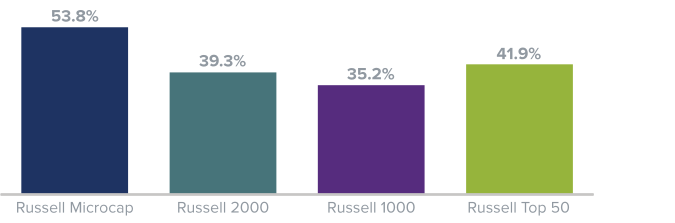
Source: Russell Investments. Past performance is no guarantee of future results.
For the year-to-date period ended 9/30/25, large-caps held their performance advantage: the Russell 2000 rose 10.4% versus 14.6% for the Russell 1000. Micro-caps, however, outpaced large-caps, rising 15.7% (while the mega-cap Russell Top 50 gained 16.5%).
Foreign affairs
Non-US stocks were cooler in the quarter, though as a group they have been more steadily positive so far in 2025, having avoided the bearish sentiment that enveloped most US indexes in 2025’s first quarter. The MSCI ACWI ex-USA Small Cap Index rose 6.7% in 3Q25, and the MSCI ACWI ex-USA Large Cap Index was up 7.2%.
The indexes were nearly tied for the year-to-date through the end of September, with the MSCI ACWI ex-USA Small Cap up 25.5% and the MSCI ACWI ex-USA Large Cap up 25.5%. Annualized returns were also close for the 1-, 3-, 5-, and 10-year periods ended 9/30/25, though small-caps had a narrow edge for only the 10-year period.
The small-cap style story
Considering the strength of mega-cap tech stocks and lower-quality small-caps in 3Q25 (as measured by returns on invested capital), the spread between the small-cap style indexes was somewhat surprising in that small-cap growth has often led in prior early phases of an upswing Yet the Russell 2000 Value Index gained 12.6% in 3Q25 versus a 12.2% return for the Russell 2000 Growth.
Small-cap growth was in the driver’s seat from 4/8/25-9/30/25, when the Russell 2000 Growth rose 43.2% versus 35.3% for the Russell 2000 Value. Small-cap growth also led for the year-to-date period ended 9/30/25, up 11.7% versus 9.0% for the small-cap value index. Over longer-term spans, the Russell 2000 Growth beat the Russell 2000 Value for the 1-, 3-, and 10-year periods while the Russell 2000 Value won for the 5-year period ended 9/30/25.
The small-cap sector story
In another gauge of the broad based gains for small-cap stocks, all 11 sectors within the Russell 2000 contributed positively in 3Q25. Industrials, information technology, health care, and consumer discretionary did especially well, and cyclical sectors had the edge over defensive sectors—as we would expect in a growing economy. Every sector but energy and real estate finished the year-to-date period in the black, with industrials and tech again leading by sizeable margins.
All 11 Sectors Contributed to 3Q25 Performance
3Q25 Sector Contributions in the Russell 2000
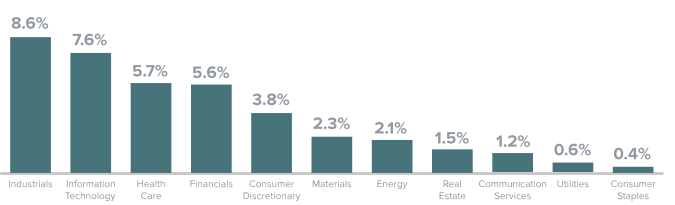
Source: Russell Investments. Past performance is no guarantee of future results.
A similar pattern could be seen in small-cap sector performance off the early April lows. From 4/8/25-9/30/25, the top contributors were Industrials, Information Technology, and Financials—and all 11 sectors were in positive territory.
The case for sustained small-cap leadership
Sky-high valuations for US equities have been the subject of many commentaries over the last few years. We think it’s important to point out, however, that most of these observations have focused on larger stocks, whether discussing the Magnificent Seven (Alphabet, Amazon, Apple, Meta, Microsoft, Nvidia, and Tesla), the Nasdaq 100, or the S&P 500. In our view, small-cap stocks remain far more reasonably valued than their larger cousins, who have received the lion’s share of the attention regarding valuations.
Two examples help explain our contention that small-cap stocks as a group are still attractively valued. The first is that the Russell 2000 as a percentage of the Russell 3000 Index has historically averaged 7.6% since late 1984. Yet even after the robust uptick off the April lows, the Russell 2000’s weight was 4.4% at the end of September, significantly below that long-term average.
Small-Cap’s Weight in the Russell 3000 is Below Historical Low
Russell 2000 Total Market Cap as a Percentage of Russell 3000 Total Market Cap (%), 9/30/84 through 9/30/25
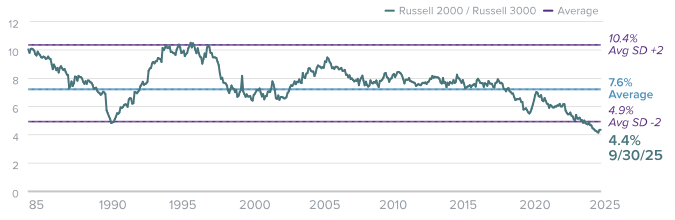
Source: FactSet. Past performance is no guarantee of future results.
Our second observation is that valuations for the Russell 2000 remained attractive relative to the Russell 1000 based on our preferred index valuation metric of EV/EBIT or enterprise value over earnings before interest and taxes.
Relative Valuations for Small-Caps vs. Large-Caps Remain Near Their Lowest in 25 Years
Russell 2000 vs. Russell 1000 Median LTM EV/EBIT (ex. Negative EBIT Companies), 9/30/00 through 9/30/25
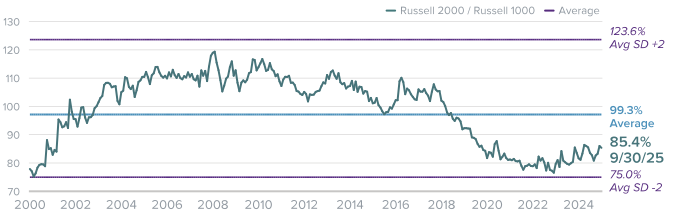
Source: FactSet. Past performance is no guarantee of future results.
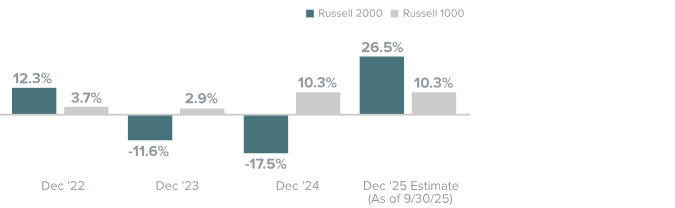
Small-cap earnings expected to be stronger than large-caps
Because the bulk of small-cap companies’ debt is floating rate, even more conservatively capitalized small-cap businesses will see some relief now that rates have come down (and may come down again in October and/or December). What gives us the most confidence, however, is that many small-cap companies are emerging from a two-year earnings recession. We therefore see the possibility that better earnings growth can boost performance for an asset class that has lagged large-cap for several years. Potentially enhancing this positive picture is the recently signed federal legislation that allows businesses to deduct up to the entire cost of eligible assets in the year they are placed in service. This accelerates deductions, reducing taxable income and augmenting cash flow in the year of purchase. To put it more simply, small-caps have considerable potential for multiple expansion through the end of 2025 and beyond. Since most of our domestic small-cap strategies focus on companies with earnings, we think it’s also worth mentioning that previous periods during which small-caps had low expectations and relatively underwhelming returns typically proved to have been opportune times to increase allocations.
Small-Cap’s Estimated Earnings Growth is Expected to Be Higher Than Large-Cap’s in 2025
One-Year EPS Growth
Source: FactSet. Past performance is no guarantee of future results.
The overarching theme for both the market and economy remains “resilience in the face of uncertainty,” which will be further tested for the duration of the federal government shutdown. And undoubtedly much is still uncertain or at least muddled: recent jobs numbers have been underwhelming, consumer confidence is still wobbly, and manufacturing data has been sluggish. We are also still not sure of where various tariffs rates, especially with critical trading partners, will ultimately settle. The country is still fiercely divided politically, and the mid-term elections, which carry the potential for congressional realignment, are a little more than a year away while geopolitical tensions have not eased.
However, consumers continue to spend, the economy has been growing, and access to capital has widened with the reduction in rates. More specifically for active small-cap investors like us, a long-sought leadership appears to have finally arrived—one that we think is supported by lower rates and a still vibrant economy. The case for small-cap leadership is further bolstered in our view by the more promising combination of attractive relative valuations and growing earnings strength. We also remain staunch believers in reversion to the mean, and we believe the long-term record of US equity returns, the recent strength of large- and mega-cap stocks notwithstanding, gives the advantage to small-caps.
Definitions
The Russell 1000 Index is an unmanaged, capitalization-weighted index of domestic large-cap stocks. It measures the performance of the 1,000 largest publicly traded US companies in the Russell 3000 Index.
The Russell 2000 Index is an index of domestic small-cap stocks that measures the performance of the 2,000 smallest publicly traded US companies in the Russell 3000 Index.
The Russell Top 50 Mega Cap Index is a market-capitalization-weighted index of the 50 largest stocks in the broad-based Russell 3000 universe of US-based equities.
The Nasdaq Composite is a stock market index that includes almost all stocks listed on the Nasdaq stock exchange.
The MSCI ACWI ex USA Small Cap Index is an unmanaged, capitalization weighted index of global small-cap stocks, excluding the United States.
The MSCI ACWI ex USA Large Cap Index is an unmanaged, capitalization weighted index of global large-cap stocks, excluding the United States.
The Standard and Poor's 500 (S&P 500) is a stock market index tracking the stock performance of 500 leading companies listed on stock exchanges in the United States.
Enterprise value (EV) refers to the entire value of a company after taking into account both holders of debt and equity.
The EV/EBIT multiple is the ratio between enterprise value (EV) and earnings before interest and taxes (EBIT).
Earnings per share (EPS) is calculated as a company’s profit divided by the outstanding shares of its common stock.
Standard deviation is a measure of the spread of data around the mean value. It is used in comparisons of consistency between different data sets.
WHAT ARE THE RISKS?
All investments involve risks, including possible loss of principal. Past performance is no guarantee of future results. Please note that an investor cannot invest directly in an index. Unmanaged index returns do not reflect any fees, expenses or sales charges.
Equity securities are subject to price fluctuation and possible loss of principal.
Commodities and currencies contain heightened risk that include market, political, regulatory, and natural conditions and may not be suitable for all investors.
Small- and mid-cap stocks involve greater risks and volatility than large-cap stocks.
Active management does not ensure gains or protect against market declines.
Any data and figures quoted in this article sourced from Russell Investments, FactSet, Bloomberg and Reuters.
Important data provider notices and terms available at www.franklintempletondatasources.com. All data is subject to change.
WF: 7024958
