
PREVIEW
Dramatic rotations between traditionally defined “growth” and “value” stocks were observed throughout this year, driven by the COVID-19 pandemic and other macro influences such as indications of rising inflation. From my perspective, investors need to reframe our thinking around the growth and value classifications. The traditional growth or value distinction for stocks based on index construction is misleading. It draws arbitrary boundaries between companies, based on simple statistical measurements and rules. Active asset managers assess company valuations in a more nuanced way, considering things like intangible assets in their valuation process. We asked five of our equity teams to offer their views on the growth versus value debate. Here are some of our key takeaways:
- Our colleagues at Mutual Series, who we consider truly deep value investors, lead off with an interesting perspective on the role of intangible assets in their valuation process. Investing in value is not just about statistical cheapness or accounting value—it requires understanding economic value.
- The value team at ClearBridge Investments disputes the popular narrative that value stocks are generally not sustainable investments. The key is an active investment approach focused on investing in high-quality businesses with competitive advantages. This approach can both generate excess returns while satisfying responsible investing objectives.
- Inflation is front and center of any discussion of markets today, and historically leads any growth versus value debate. Some managers believe the recent uptick in inflation could become a secular trend, resulting in a sustained rotation from growth to value style investing. The innovation team at Franklin Equity Group disagrees and holds tight to its long-held philosophy that innovation is implicitly deflationary over time.
- In the tradition of Sir John Templeton, Templeton Global Equity Group suggests that too often, particularly in passive investment strategies, investors think formulaically or one-dimensionally about value. They call their approach “compound value,” because—like a chemical compound— it results from the union of multiple elements that can include price, quality, growth and event—the tangible, fundamental and probable change likely to unlock value.
- Specialists in the small-capitalization (small-cap) space, our colleagues at Royce find that the COVID-19 pandemic offered many quality businesses the opportunity to prove their durability. Companies were able to bolster competitive positions and emerge with greater earnings and cash flow power. Many of the defensive measures taken to preserve cash flow have also evolved into permanently reduced cost structures.

Stephen Dover, CFA
Chief Market Strategist
Franklin Templeton Investment Institute
A FALSE DICHOTOMY
The growth versus value argument begs the question—what are we referring to when we talk “growth” versus “value” stocks? How is this distinction made? And perhaps most significantly for active asset managers, should these concepts be considered mutually exclusive?
We asked several of our investment managers to weigh in on the discussion around growth and value. Despite their different investment philosophies and processes, they all agreed that the traditional growth or value distinction (see “Growth Versus Value: A Primer” section below) for stocks is misleading. It attempts to draw boundaries between companies based on statistical measurements and rules, where active asset managers assess each company individually. Defining and assessing a growth or value investment is nuanced. It is not binary—and should not always be thought of as mutually exclusive. Is it hot or is it sunny? Perhaps both. Presumably, growth is not without value, and vice versa. There’s a lot of overlap.
As my colleague from Templeton Global Equity Group, Sandy Nairn, recently observed, “we are corralled into a discussion based on index methodologies that often make little sense. A US value stock could be a growth stock if it changed its domicile to Europe, for example.” Adding to the nuance, as stocks evolve, they will often shift between these traditional “value” and “growth” statistical characterizations.
In some ways, the bucketing of value and growth suggests investors are pursuing different outcomes, which of course they are not. The journey may be different in terms of process, but the end objective is the same—to buy assets at a discount to intrinsic value. This is the universal goal. Finding and measuring that discount is the challenge. One of the current challenges in valuing companies and distinguishing between growth and value is considering intangible assets which, by definition, are not included in standard accounting practices.
With all the interest in intangibles, in the Investment Institute we created intangible-intensity rankings to gauge which sector and country valuations may be more impacted. The general conclusions are informative. Sectors that have high intangible sensitivity include health care, information technology, and communication services. These are companies whose business models are committed to investments in innovation and effective processes. From a geographical perspective, developed markets are more intangible-intensive relative to emerging economies, which could help explain some of the relative outperformance seen in the developed world.
ECONOMIC VALUE AND QUALITY
When considering the attractiveness of an investment, our managers prefer to think in terms of “economic value” and “quality.” These measures require more in-depth, rigorous analysis of company fundamentals. Economic value is not listed on a company’s financial statements. Simple ratios like price-to-book (P/B) and price-to-earnings (P/E) do not capture all economic value, and they fall short when identifying quality stocks. For example, when adjusting for research & development (R&D) and operating expenses as part of the earnings calculation, the P/E of traditional growth stocks narrow their premium over value stocks.
In Chapter 1, our colleagues at Mutual Series expand on the idea of economic value, observing that the accounting value of an asset, which is the value listed on the balance sheet, can differ meaningfully from the underlying economic value of the asset. Economic value reflects things like competitive positioning in the marketplace, business strategy, corporate culture of innovation, growth prospects, and perhaps most significantly, intangible assets such as R&D or intellectual property. These are non-monetary assets without physical substance, but in today’s marketplace they are very significant to valuations. According to research we have done within the Institute, around 90% of the S&P 500 Index’s market capitalization can be attributed to intangible assets at the end of 2020, as compared to roughly 36% at the end of 1985, as seen in Exhibit 1. Companies that invest heavily in intangibles—meaning non-physical assets—like information technology infrastructure, branding and R&D have significantly outperformed hard-asset-heavy counterparts.
THE GROWING SHIFT TO INTANGIBLES
Exhibit 1: Intangible and tangible assets as percentage of S&P 500 Index market value (in US$)
December 31, 1985–December 31, 2020
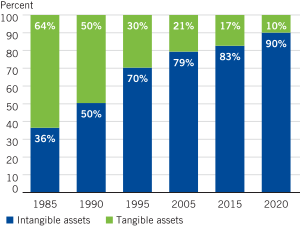
Source: Franklin Templeton Investment Institute, FactSet. As of May 2021. Net tangible assets are used, which are calculated as total assets minus intangible assets (report on balance sheet), less total liabilities. Portion of mark value related to intangible assets is calculated by subtracting net tangible assets from market capitalization. The analysis on a constituent level and arithmetic sum is used as an aggregation method. Indexes are unmanaged and one cannot directly invest in them. They do not include fees, expenses or sales charges. Past performance is not an indicator or a guarantee of future results.
In Chapter 2, our colleagues at ClearBridge Investments discuss their approach to sourcing high-quality stocks in the value space that offer the potential for excess returns and satisfy environmental, social and governance (ESG) objectives as well. This is very interesting, as historically, value stocks have been considered part of resource-intensive, heavy emitting sectors. This assumption is based on the composition of passive indexes, such as the Russell 1000 Value Index, which is comprised largely of sectors with high carbon intensity (hence the association of value investing and old economy smokestack industries).
As active investors, however, ClearBridge has been successful in sourcing high-quality businesses that offer both value and sustainability. For example, the Deere company, which manufactures agricultural, construction and forestry equipment, is firmly ensconced in the industrials sector. Typically, Deere would be overlooked by sustainability focused investors, assumed to be a capital and carbon-intensive company. On the contrary, Deere is a leader in precision agriculture and its use of artificial intelligence to improve application of agrichemicals is discussed in detail in our piece.
With inflation a hot topic as it pertains to any discussion of growth versus value, Franklin Equity Group offers an interesting perspective in Chapter 3 on the role of innovation and its inherently deflationary characteristics. Consider the rise of asset-light businesses as an example—companies with the many intangible assets discussed earlier. Asset-light companies’ lower inflation by reducing capital expenditures and increasing market supply, which then reduces costs to end consumers. These companies have lower capital requirements for investments. For example, e-commerce companies do not buy expensive store fronts; ride-sharing companies do not buy their own vehicles, etc. Not only can this reduce inflationary pressures on the prices of real estate and cars, but these businesses have variable-cost structures that keep costs lower. Asset-light models are cheaper to run than a traditional retailer who pays a fixed rent/commercial mortgage, or a taxi company that must own, maintain, and store its own cars.
In Chapter 4, our colleagues at Royce find that the COVID-19 pandemic offered many quality businesses in the small-cap value space the opportunity to prove their durability. They were also able to bolster competitive positions and emerge with greater earnings and cash flow power. Many of the defensive measures taken to preserve cash flow have evolved into permanently reduced cost structures, such as smaller real estate footprints from permanent moves to hybrid or full work-from-home models. These higher-quality companies had the balance sheet strength to make these moves, while smaller or more highly leveraged competitors were focused mostly on survival. This has strengthened their moats, broadened their addressable markets, and/or increased their long-term, “normalized” operating margins relative to pre-pandemic levels.
Finally, our colleagues at Templeton Global Equity Group highlight their approach to finding true quality and economic value in Chapter 5 with the introduction of their “compound value” approach. The team suggests, as we have observed, that the concept of value is too often associated with the value factor, causing investors to think formulaically or one-dimensionally about stock selection. Like a chemical compound, compound value results from the union of multiple elements, including cash flow and assets (price), intangible assets, predictability and risks associated with fundamentals (quality), the rate of change and sustainability of growth, and probability of tangible events likely to unlock value.
The approach is rooted in the philosophy of our founder, Sir John Templeton. “Remain flexible and open-minded about types of investment,” he wrote. “There are times to buy blue chip stocks, cyclical stocks, corporate bonds, US Treasury instruments, and so on. And there are times to sit on cash … The fact is that there is no one kind of investment that is always best.”
Indeed, as active asset managers, our different investment teams seek to build portfolios that may not align with narrowly defined and arbitrary labels. Value and growth are generic terms. A good growth or value manager will think within their parameters, but even in those parameters they are selecting stocks in an idiosyncratic way. It is about how they make valuation decisions.
Franklin Templeton Thinks: Equity Markets highlights the global views our equity investment teams have across developed and emerging economies, sectors, and individual companies. Each quarterly issue spotlights fresh insights that our analysts and portfolio managers bring to active security research, examining risks and opportunities from both growth and value frameworks.
About the Franklin Templeton Investment Institute. The mission of the Investment Institute is to deliver research-driven insights, expert views and industry-leading events for clients and investors globally through the diverse expertise of our autonomous investment groups, select academic partners and our unique global footprint.
Contributors

WHAT ARE THE RISKS?
All investments involve risks, including possible loss of principal. The value of investments can go down as well as up, and investors may not get back the full amount invested. Stock prices fluctuate, sometimes rapidly and dramatically, due to factors affecting individual companies, particular industries or sectors, or general market conditions. Special risks are associated with foreign investing, including currency fluctuations, economic instability and political developments. Investments in emerging markets involve heightened risks related to the same factors, in addition to those associated with these markets’ smaller size and lesser liquidity. The companies and case studies shown herein are used solely for illustrative purposes; any investment may or may not be currently held by any portfolio advised by Franklin Templeton Investments. The opinions are intended solely to provide insight into how securities are analyzed. The information provided is not a recommendation or individual investment advice for any particular security, strategy, or investment product and is not an indication of the trading intent of any Franklin Templeton managed portfolio. This is not a complete analysis of every material fact regarding any industry, security or investment and should not be viewed as an investment recommendation. This is intended to provide insight into the portfolio selection and research process. Factual statements are taken from sources considered reliable, but have not been independently verified for completeness or accuracy. These opinions may not be relied upon as investment advice or as an offer for any particular security. Impact investing and/or Environmental, Social and Governance (ESG) managers may take into consideration factors beyond traditional financial information to select securities, which could result in relative investment performance deviating from other strategies or broad market benchmarks, depending on whether such sectors or investments are in or out of favor in the market. Further, ESG strategies may rely on certain values-based criteria to eliminate exposures found in similar strategies or broad market benchmarks, which could also result in relative investment performance deviating.
Actively managed strategies could experience losses if the investment manager’s judgment about markets, interest rates or the attractiveness, relative values, liquidity or potential appreciation of particular investments made for a portfolio, proves to be incorrect. There can be no guarantee that an investment manager’s investment techniques or decisions will produce the desired results. Investments in fast-growing industries like the technology and health care sectors (which have historically been volatile) could result in increased price fluctuation, especially over the short term, due to the rapid pace of product change and development and changes in government regulation of companies emphasizing scientific or technological advancement or regulatory approval for new drugs and medical instruments.