

CONTRIBUTORS

Francis Gannon
Co-Chief Investment Officer, Managing Director, Royce Investment Partners

Chris Clark
Chief Executive Officer, Co-Chief Investment Officer & President, RFS
The first half’s weird and wild weather
So far, 2025 has given us nearly every kind of investment weather, from the cold and rainy—that is, volatile and bearish—first quarter to the placid and pleasant days that constituted most of the second. To be sure, we suspect that many investors feel like at least a year’s worth of weather was somehow crammed into the first seven months of the year. We think it’s notable that the first half of 2025—which could be described as “A Tale of Two Quarters”—saw few (if any) of the elements that drove stock prices down in the first quarter removed or resolved in the second quarter. In other words, investors still face a long list of uncertainties and challenges, including ongoing war and violence in the Ukraine and Gaza, rapid shifts in tariff rates and implementation, stubborn (and possibly increasing) inflation, and an overall anxiety about the state of the economy, whether thinking globally or locally.
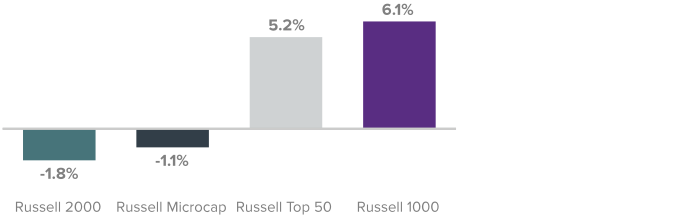
Unfortunately for small-cap investors and dedicated asset class devotees like us, however, the combination of 2Q25’s welcome rebound and concurrent lower volatility did not shift market leadership. In part because of the first quarter’s steep declines, which hit small-caps harder than their bigger siblings, year-to-date results for the period ended 6/30/25 were not positive across the board. Small- and micro-cap stocks remained underwater through the end of June, with the Russell 2000 falling -1.8% while the Russell Microcap lost -1.1%. The large-cap Russell 1000 Index, however, gained 6.1%, and the Russell Top 50 Index rose 5.2% for the year-to-date period ended 6/30/25. July was a positive month for small- and large-caps alike, though it was not strong enough to pull the small- and micro-cap indexes into the black on a year-to-date basis. As frustrating as the last several years have been for small-cap investors, the long cycle of mega- and large-cap leadership kept its streak alive through the end of July. We delve into why this leadership cycle can shift below.
Bigger Stayed Better in the Year’s First Half
Russell Index Returns YTD through 6/30/25
Source: Russell Investments. Past performance is no guarantee of future results.
What’s working in US small-cap
As volatility began to ebb following the small-cap bottom on 4/8/25, the Russell 2000 advanced 24.0% through the end of June. And although both small-cap style indexes had impressive, double-digit returns, small-cap growth led during the upswing, with the Russell 2000 Growth Index climbing 27.7% while the Russell 2000 Value Index rose 20.2%. In addition to growth doing better than value within small-cap, the highest returns in both the second quarter and off the small-cap low on 4/8/25 came from stocks with no dividends, no earnings, and low or no ROIC (returns on invested capital—a profitability and capital allocation metric we use to gauge quality).
This kind of high-growth, low-quality rally is consistent with previous small-cap rebounds following corrections. (And small-caps experienced a genuine bear market—that is, a decline of 20% or more from a previous peak—from the Russell 2000’s peak on 11/25/24 through 4/8/25, when the index fell 27.5%.) If the past is prologue, however, higher quality small-cap stocks, as well as those with dividends, should begin to outpace those of lower quality, assuming that the current rally continues—the last week of July notwithstanding.
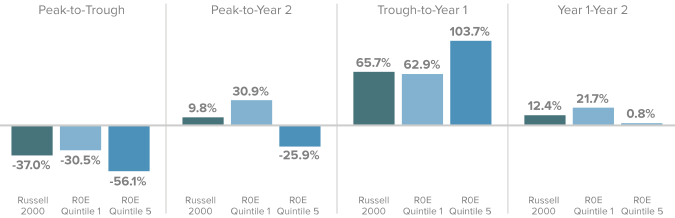
We broke down the Russell 2000 into quintiles of return on equity (ROE), another quality metric that measures a company’s financial performance. It’s calculated by dividing net income by shareholders’ equity. Higher ROE generally means that a company’s management has allocated capital effectively. As the chart shows, higher ROE small-caps begin to outperform the longer a bullish run was extended, perhaps the result of investors seeking more profitable companies once they felt greater confidence in the upswing’s longevity.
Low-Quality Has Led Early While High-Quality Has Led in the Second Year of Small-Cap Rebounds
Average Russell 2000 ROE Quintile Performance Over the Last 25 Years, Including the Past Six Drawdown Periods and Past Five Recoveries1 as of 6/30/25
Source: Russell Investments. There is one less period for the recoveries as the most recent cycle had not reached a new peak as of 6/30/25. Past performance is no guarantee of future results.
Some of the highest returns for the first six months of 2025 came from non-US equities and were especially good for small-caps. The MSCI ACWI ex-USA Small Cap Index rose 17.7% for the first half of 2025 while its large-cap counterpart was up 17.1%. Year-to-date through the end of July, small-caps built their advantage—the MSCI ACWI ex-USA Small Cap Index advanced 17.9% while its large-cap counterpart gained 16.8% for the same period. So, while many investors have taken flight away from US issuers amid concerns about our economy and near-term corporate profit prospects, we think it should be noted that the US economy has, like the capital markets, shown remarkable resilience during some highly challenging days so far in 2025. Moreover, non-US stocks have just begun to reverse a long period of underperformance versus domestic equities, which gave many international companies attractively low valuations at the end of 2024.
Volatility is an ally
Between the beginning of 2025 and the end of July, an interesting dynamic was at work, which we might characterize as the rise and fall of volatility. Stocks were highly volatile in both the run up to and immediate aftermath of “Liberation Day” on April 2, with most share prices cratering before beginning to recover more steadily in May. There was heightened volatility not just from the VIX—the CBOE S&P 500 Volatility Index, often referred to as the “fear gauge”—but also when tracking the number of trading days when the small-cap Russell 2000 Index moved up or down at least 1%. During April of 2025, 62% of trading days (13 out of 21) had such moves; in May there were only 33.3% of days (7 out of 21). The average for the first six months of 2025 was 46%—while going back to 2000, the annual average was 42% of trading days. So far this year, then, small-caps have shown either higher-than-usual volatility or were comparatively calm. In essence, the story of the first half was that stocks of all sizes were volatile—until they weren’t.
Yet regardless of market cap, style, or geography, we expect stock prices to remain volatile for the rest of the year, if for no other reason than that the market hates few things more than uncertainty—and “uncertainty” certainly appears to be the watchword for the next several months. For all the pro-growth policies and relaxed regulations that are being proposed or have already been implemented, US President Trump’s second term has already created a lot of economic anxiety, most of it centered on tariffs. Going back to November, we knew that there would be Republicans in control of both Houses of Congress and the White House—which signaled stability to the capital markets. This has nothing to do with ideology; it is about giving investors a reasonably good idea of what the policy backdrop will look like going forward.
Many investors felt confident that any tariffs would be used as a negotiating tactic. But they have so far ended up being higher and deployed much more capriciously than anyone was expecting. This kind of uncertainty typically wreaks havoc on stock prices. At the same time, the impressive recovery for US stocks suggests that investors have learned to expect the unexpected from the Trump Administration—which has so far also been a boon to valuation-conscious investors like us who see volatility as an opportunity. Our investment teams have been working diligently to take advantage of short-term moves in order to build positive long-term performance.
Certainly uncertain
So, while we welcome volatility in the short run, we also acknowledge that attempting to chart a course for small-cap stocks, or any other asset, is even more challenging than usual. Recent gross domestic product (GDP) growth offers a useful example. The first quarter showed the US economy contracting at an annualized rate of -0.5% while the second quarter number was 3%. This disjunct can be explained in part by slower consumer spending throughout the first half of 2025 as well as by the fevered pace of pre-tariff inventory stockpiling in the first quarter that was followed by a precipitous drop in imports in the second quarter. The upshot was a first-half average of 1.25% annualized GDP growth, a full percentage point lower than the pace set in 2024. The downward trend in consumer spending (to say nothing of the decline in consumer confidence) is especially worrisome since that spending accounts for two-thirds of GDP. The 1.4% advance in consumer spending for 2Q25 was an improvement from the underwhelming 0.5% figure that kicked off 2025—but it was also most subdued pace in consecutive quarters since the pandemic. Adding to the uncertainty about the days ahead was the slower pace of business investment in the second quarter.
Then there was the mixed bag of economic data that the Federal Reserve then (Fed) outlined when announcing in late July that interest rates would hold steady until at least September. In its statement on July 30, the Fed said, “Although swings in net exports continue to affect the data, recent indicators suggest that growth of economic activity moderated in the first half of the year. The unemployment rate remains low, and labor market conditions remain solid. Inflation remains somewhat elevated.” In other words, we have no clear direction for where the economy is headed. (It’s also worth noting that two of the three remaining Federal Open Market Committee (FOMC) meetings—September’s and December’s—will also have the central bank’s Summary of Economic Projections.)
At the risk of understatement, much remains unsettled around tariffs. Preliminary arrangements have been worked out with Japan, the European Union, and other nations, though the possibility of higher tariffs persists (as of this writing) for China and Mexico—two of the United State’s most important trading partners. On July 31, Trump unveiled sweeping tariffs on several countries, including a hefty (and unreasonable in our view) 35% tariff on Canadian imports while he threatened India with 25% tariffs for purchasing energy and weapons from Russia. There were also contradictory reports around what would and would not be subject to tariffs on imports from the EU in addition to unresolved questions around that region’s purchases of US energy, steel, and aluminum. Needless to say, uncertainty sums up much that is happening on the economic policy front so far this year. Yet resilience has been equally important. For us as active small-cap specialists, the first half’s most welcome news has been the generally positive slate of earnings across the market so far.
Four charts outline an optimistic US small-cap forecast
Most importantly, we remain confident about the long-term prospects for our chosen asset class. When looking ahead, there’s always far more that we don’t know than we do. Even the best-informed and data-driven observations involve some guesswork. We always think that history offers a useful guide, while also being mindful that each historical period comes with its own context; similar conditions may yield markedly different results. And as we’ve detailed, our current situation has more than its share of sizable unknowns. Along with the ultimate arrangement and implementation of tariffs, we have an increasingly divided electorate and the prospect of shifting congressional control in 2026. The state of geopolitics remains fraught with dangers and risks.
Yet there are also bright spots: The effects of reshoring, reindustrializing, and infrastructure improvements have not yet reached their respective ends. As we mentioned above, both the capital markets and economy proved remarkably resilient throughout the challenging first half of 2025.
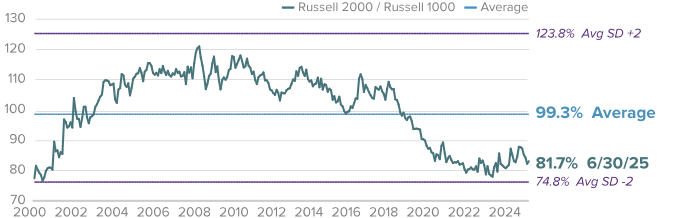
Against this backdrop, there is also what we do know—and small-cap stocks are what we know best. At the end of June, the Russell 2000 remained much less expensive than the Russell 1000. Based on our preferred index valuation metric, EV/EBIT or enterprise value over earnings before interest and taxes, small-caps stayed close to a 25-year low relative to large-cap stocks.
Relative Valuations for Small-Caps vs. Large-Caps are Near Their Lowest in 25 Years
Russell 2000 vs. Russell 1000 Median Last Twelve Months EV/EBIT (ex. Negative EBIT Companies)
6/30/00-6/30/25
Source: FactSet Enterprise Value/Earnings Before Interest and Taxes. SD = Standard Deviation.
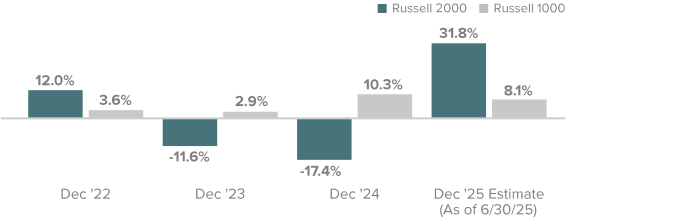
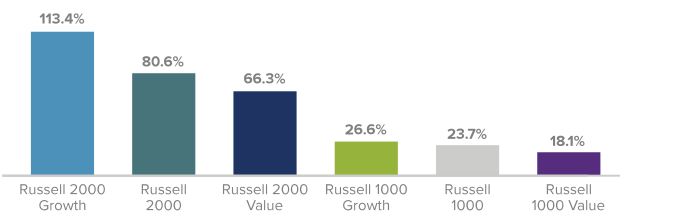
We think that small-cap stocks much more attractive valuations become even more compelling when combined with the promising earnings outlook vis-à-vis large-caps, as seen in the two charts below.
Small-Cap Stocks' Estimated Earnings Growth Is Forecast to Be Higher Than Large-Caps in 2025
One-Year EPS Growth
Source: FactSet. Earnings per share (EPS) is calculated as a company’s profit divided by the outstanding shares of its common stock. The EPS Growth Estimates are the pre-calculated mean one-year EPS growth rate estimates by brokerage analysts. Estimates are the average of those provided by analysts working for brokerage firms who provide research coverage on each individual security as reported by FactSet. All non-equity securities, investment companies, companies without brokerage analyst coverage are excluded. There is no assurance that any estimate, forecast or projection will be realized.
Average Expected Earnings Growth for 2025-2026
Index Aggregate Estimated Two-Year EPS Growth
Source: FactSet. There is no assurance that any estimate, forecast or projection will be realized.
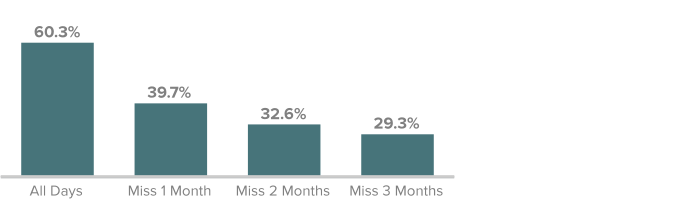
Moreover, many small-caps stocks are just starting to emerge from a two-year earnings recession, which, we believe, should help boost performance for an asset class that’s lagged large-cap for several years and currently faces low expectations. And previous low expectations and relatively underwhelming returns have often been opportune times to increase allocations. Historically, we have found that sitting on the sidelines during corrections or the early stage of rallies has carried a high cost. We therefore welcome a market environment, however challenging (and even confusing at times thanks to the chaos around tariffs).
Missing the Rally’s Earliest Stage Has Proven Costly
Average 12-Month Returns for the Russell 2000 During a Recovery Depending on Various Entry Points, 10/5/79-6/30/25
Source: Russell Investments. Past performance is no guarantee of future results.
The market continues to present our investment teams with highly promising long-term opportunities—which tend to proliferate when markets are struggling and/or experiencing elevated volatility. As we move further into the year, we remain highly constructive on the potential for small-cap leadership and for our active approaches to building portfolios. Amid the difficulties of volatile markets and periods of economic uncertainty, we also think it’s crucial to remind investors of the opportunity to build their small-cap allocation at attractively low prices. History shows the potential rewards for investors who had the necessary patience and discipline to stay invested during periods of sluggish or negative performance. We continue to see the currently unsettled period as an opportune time to invest in select small-caps for the long run.
Definitions
The Russell 1000 Index is an unmanaged, capitalization-weighted index of domestic large-cap stocks. It measures the performance of the 1,000 largest publicly traded US companies in the Russell 3000 Index.
The Russell 2000 Index is an index of domestic small-cap stocks that measures the performance of the 2,000 smallest publicly traded US companies in the Russell 3000 Index.
The Russell 2000 Value and Growth indexes consist of the respective value and growth stocks within the Russell 2000 as determined by Russell Investments.
The Russell Top 200 Index measures the performance of the 200 largest companies in the Russell 1000 Index.
The Russell Microcap Index measures the performance of the microcap segment of the US equity market.
The Russell Top 50 Mega Cap Index is a market-capitalization-weighted index of the 50 largest stocks in the broad-based Russell 3000 universe of US-based equities.
The MSCI ACWI ex USA Small Cap Index is an unmanaged, capitalization weighted index of global small-cap stocks, excluding the United States.
The Nasdaq Composite is a stock market index that includes almost all stocks listed on the Nasdaq stock exchange.
VIX is the ticker symbol and popular name for the Chicago Board Options Exchange's CBOE Volatility Index, a popular measure of the stock market's expectation of volatility based on S&P 500 index options.
WHAT ARE THE RISKS?
All investments involve risks, including possible loss of principal. Past performance is no guarantee of future results. Please note that an investor cannot invest directly in an index. Unmanaged index returns do not reflect any fees, expenses or sales charges.
Equity securities are subject to price fluctuation and possible loss of principal.
Commodities and currencies contain heightened risk that include market, political, regulatory, and natural conditions and may not be suitable for all investors.
Small- and mid-cap stocks involve greater risks and volatility than large-cap stocks.
US Treasuries are direct debt obligations issued and backed by the “full faith and credit” of the US government. The US government guarantees the principal and interest payments on US Treasuries when the securities are held to maturity. Unlike US Treasuries, debt securities issued by the federal agencies and instrumentalities and related investments may or may not be backed by the full faith and credit of the US government. Even when the US government guarantees principal and interest payments on securities, this guarantee does not apply to losses resulting from declines in the market value of these securities.
Investments in fast-growing industries like the technology sector (which historically has been volatile) could result in increased price fluctuation, especially over the short term, due to the rapid pace of product change and development and changes in government regulation of companies emphasizing scientific or technological advancement or regulatory approval for new drugs and medical instruments.
Any companies and/or case studies referenced herein are used solely for illustrative purposes; any investment may or may not be currently held by any portfolio advised by Franklin Templeton. The information provided is not a recommendation or individual investment advice for any particular security, strategy, or investment product and is not an indication of the trading intent of any Franklin Templeton managed portfolio. Past performance does not guarantee future results.
Any data and figures quoted in this article sourced from Russell Investments, FactSet, Bloomberg and Reuters.
Important data provider notices and terms available at www.franklintempletondatasources.com. All data is subject to change.
WF: 6442266
