

CONTRIBUTORS

Francis Gannon
Co-Chief Investment Officer, Managing Director, Royce Investment Partners
Uncertainty + volatility = A down quarter
The first quarter of 2025 was a challenging one for U.S. equities. Tariff talk (as well as a volatility inducing "now you see it, now you don’t” approach to implementation), stubborn inflation, declining consumer confidence, and a consequent revival of recession worries conspired to keep many stocks underwater through February and most of March. Markets hate few things more than uncertainty, and the first quarter seemed to offer a lot more than the usual amount.
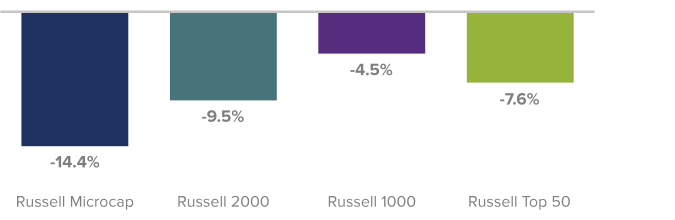
The small-cap Russell 2000 Index fell -9.5% versus a loss of -4.5% for the large-cap Russell 1000 Index. Yet large-cap’s outperformance was not concentrated among the small cohort of mega-cap stocks that have dominated performance over the last several years: the Russell Top 50 Index declined -7.6% in 1Q25 while the tech-heavy Nasdaq Composite was down -10.3%.
A Challenging Quarter for US Stocks
1Q25 Russell Index Returns
Source: Russell Investments. Past performance is no guarantee of future results.
With the Russell Microcap Index losing -14.4% for the first quarter, the year’s first three months offered little in the form of a capitalization-driven performance pattern. If anything, the period saw a flight away from the Magnificent 7, the tech-driven mega-cap group consisting of Alphabet, Amazon, Apple, Meta, Microsoft, Nvidia, and Tesla, all of which endured losses in 1Q25. The recent de-coupling of the Magnificent 7 from the bulk of large-cap results is a trend we’ll be watching closely as a broadening market has historically meant good things for long-term small-cap performance on both an absolute and relative basis.
Foreign affairs
In stark contrast to their stateside peers, non-U.S. stocks enjoyed a welcome start to 2025. Both the MSCI ACWI ex-USA Small Cap and MSCI ACWI ex-USA Large-Cap Indexes began to turn the page from 2024’s negative fourth quarter to start this year in the black. The MSCI ACWI ex-USA Small Cap gained 0.6% in 1Q25 while its large-cap counterpart was up 5.5%, in each case shaking off the combination of political unrest in Germany, France, and Canada, as well as China’s ongoing economic slump, that contributed to 2024 ending on a down note.
For the 1- and 3-year periods ended 3/31/25, non-U.S. large-caps had the relative advantage, while the MSCI ACWI ex-USA Small Cap led for the five- and 10-year periods ended 3/31/25.
Small-cap style recap
As might be expected during a downdraft, even a so far short-lived one, the Russell 2000 Value Index held its value better than the Russell 2000 Growth Index, down -7.7% versus –11.1% in 1Q25.
Over the last few years, we have noted how the small-cap style indexes had been alternating performance leadership in an odd kind of symmetry—an observation that held for recent longer-term periods. The Russell 2000 Value beat its small-cap growth sibling for the 1- and 5-year periods ended 3/31/25 while trailing the Russell 2000 Growth for the 3-year period. Interestingly, the indexes were essentially even for the 10-year period ended 3/31/25, when each advanced 6.1%.
Finally, the Russell 2000 Value lost far less from the previous small-cap peak on 11/8/21 through the end of 1Q25, down -7.6% versus a loss of -19.7% for the Russell 2000 Growth, a result more in line with the small-cap value index’s long-term pattern of losing less during downturns and/or highly volatile markets. (From the Russell 2000’s most recent peak on 11/24/24 through 3/31/25, the small-cap value index also won, though by a narrower margin, down -14.7% vs. -17.2%.)
The small-cap sector story
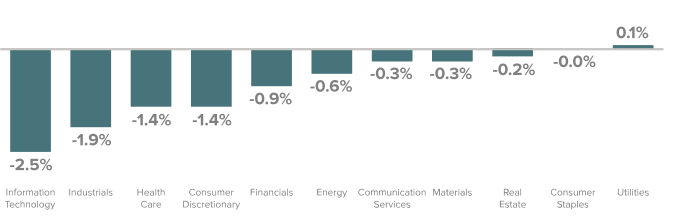
Within the Russell 2000, 10 of 11 sectors detracted from performance in 1Q25, with the biggest negative impacts coming from information technology, industrials, health care, and consumer discretionary. Utilities was the only positive contributors—making a modest gain—while consumer staples and real estate detracted the least. Defensive sectors—consumer staples, health care, real estate, and utilities—lost far less than their cyclical counterparts. This contrasted with 4Q24, when 10 of 11 sectors finished the quarter in the black.
10 of 11 Sectors Detracted from 1Q25 Performance
1Q25 Sector Detractions in the Russell 2000
Source: Russell Investments. Past performance is no guarantee of future results.
The bulk of the small-cap tech sector’s detractions came from the software and the semiconductors & semiconductor equipment industries, which, along with biotechnology, were the third biggest detractors among the Russell 2000’s industries. Even with these industries having significant detractions, the small-cap downturn was more evenly distributed among sectors, industries, and, of course, companies.
Corrections happen…it’s how one responds that matters
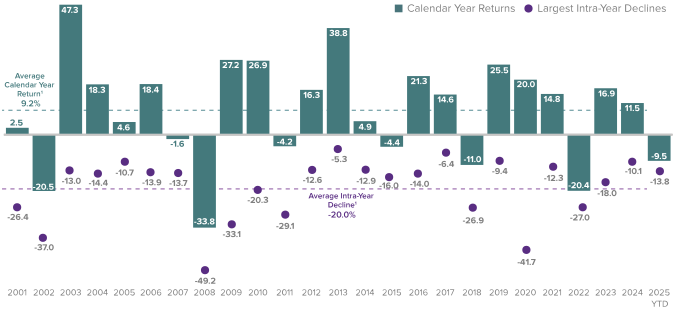
It’s too early to tell if the first quarter was a short-term downdraft or the onset of a more sustained period of falling share prices. One crucial advantage to having been small-cap specialists for more than 50 years, however, is being accustomed to corrections and bear markets. We have always sought to act on the idea of being greedy when others are fearful and fearful when others are greedy. The chart below shows how common intra-year declines have been in otherwise positive years for small-cap stocks.
Large Intra-Year Declines Are Frequent
Russell 2000 Calendar-Returns and Intra-Calendar-Year Largest Declines, 12/31/00-3/31/25
Source: Russell Investments. 1Year-to-date data is not included in averages. Past performance is no guarantee of future results.
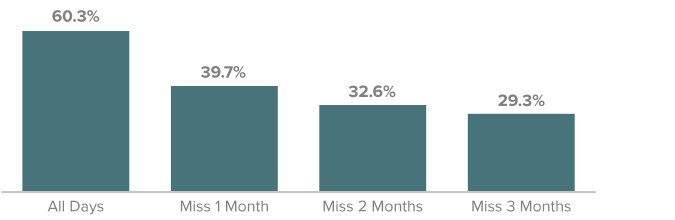
Of course, we also understand that psychology makes it difficult to keep investing when prices are falling—but we have seen over the years that panic selling or staying on the sidelines during downturns can be costly over the long run.
Missing the Rally’s Earliest Stage Has Been Costly
Average 12 Month Returns for the Russell 2000 During a Recovery Depending on Various Entry Points, 10/5/79-3/31/25
Source: Russell Investments. Past performance is no guarantee of future results.
To be sure, we wonder if small-cap investors—particularly active small-cap investors—have a psychological advantage over our large-cap peers: corrections have in the past occurred more frequently in the small-cap space. In fact, we believe that staying invested during downturns is one of the most important ingredients in the long-term success of any active investment approach in the equity universe, regardless of style or market cap.
A sunny outlook despite uncertain weather
We are admittedly facing uncertain days. The worrisome signs we listed earlier—tariffs, inflation, and falling consumer confidence are all legitimate concerns. If we do endure a recession—or even a period of stagflation—we will continue to hunt for attractive stock prices in companies that also have some combination of low debt, robust cash flows, established earnings histories, strong long-term growth prospects, and proven management. We think it’s also important to remember that difficult economic and/or market phases are finite. Those who stand to profit most when a recovery arrives are almost always those investors who stayed the course during stormy weather.
In the event that these concerns prove to be overheated, and the economy continues to grow, we see high potential for a sustained period of small-cap leadership. Based on our metric of choice to gauge index valuations, enterprise value over earnings before interest and taxes (EV/EBIT), the Russell 2000 remains far more attractively valued than the Russell 1000.
While promising in terms of an eventual reversion to the mean, the valuation situation becomes even more compelling when consensus earnings growth is factored in. At the end of 2024, the Russell 2000 was estimated to enjoy stronger earnings growth in 2025 than the Russell 1000, based on earnings per share. (Earnings per share (EPS) is calculated as a company’s profit divided by the outstanding shares of its common stock. The EPS Growth Estimates are the pre-calculated mean one-year EPS growth rate estimates by brokerage analysts. Estimates are the average of those provided by analysts working for brokerage firms who provide research coverage on each individual security as reported by FactSet. All non-equity securities, investment companies, companies without brokerage analyst coverage are excluded. Source: FactSet.)
We welcome a market environment that continues to present our investment teams with highly promising long-term opportunities, which become easier to find at attractively cheap prices when markets are struggling or experiencing elevated volatility. As we move further into the year, we remain highly constructive on the potential for small-cap leadership and for our active approaches to building portfolios.
Definitions
The Russell 1000 Index is an unmanaged, capitalization-weighted index of domestic large-cap stocks. It measures the performance of the 1,000 largest publicly traded US companies in the Russell 3000 Index.
The Russell 2000 Index is an index of domestic small-cap stocks that measures the performance of the 2,000 smallest publicly traded US companies in the Russell 3000 Index.
The Russell 2000 Value and Growth indexes consist of the respective value and growth stocks within the Russell 2000 as determined by Russell Investments.
The Russell Microcap Index measures the performance of the microcap segment of the US equity market.
The Russell Top 50 Mega Cap Index is a market-capitalization-weighted index of the 50 largest stocks in the broad-based Russell 3000 universe of US-based equities.
The MSCI ACWI ex USA Small Cap Index is an unmanaged, capitalization weighted index of global small-cap stocks, excluding the United States.
The MSCI ACWI ex USA Large Cap Index is an unmanaged, capitalization weighted index of global large-cap stocks, excluding the United States.
Enterprise value (EV) refers to the entire value of a company after taking into account both holders of debt and equity.
The EV/EBIT multiple is the ratio between enterprise value (EV) and earnings before interest and taxes (EBIT).
WHAT ARE THE RISKS?
All investments involve risks, including possible loss of principal. Past performance is no guarantee of future results. Please note that an investor cannot invest directly in an index. Unmanaged index returns do not reflect any fees, expenses or sales charges.
Equity securities are subject to price fluctuation and possible loss of principal.
Commodities and currencies contain heightened risk that include market, political, regulatory, and natural conditions and may not be suitable for all investors.
Small- and mid-cap stocks involve greater risks and volatility than large-cap stocks.
US Treasuries are direct debt obligations issued and backed by the “full faith and credit” of the US government. The US government guarantees the principal and interest payments on US Treasuries when the securities are held to maturity. Unlike US Treasuries, debt securities issued by the federal agencies and instrumentalities and related investments may or may not be backed by the full faith and credit of the US government. Even when the US government guarantees principal and interest payments on securities, this guarantee does not apply to losses resulting from declines in the market value of these securities.
Any companies and/or case studies referenced herein are used solely for illustrative purposes; any investment may or may not be currently held by any portfolio advised by Franklin Templeton. The information provided is not a recommendation or individual investment advice for any particular security, strategy, or investment product and is not an indication of the trading intent of any Franklin Templeton managed portfolio. Past performance does not guarantee future results.
Any data and figures quoted in this article sourced from Russell Investments, FactSet, Bloomberg and Reuters.
Important data provider notices and terms available at www.franklintempletondatasources.com. All data is subject to change.
