

CONTRIBUTORS

Andrew Ness
Portfolio Manager, Franklin Templeton Emerging Markets Equity
United Kingdom
Diversification isn’t a new concept for investors. Most portfolios have an element of geographic diversification, typically through global equity allocations that are anchored in developed economies. That structure has been effective in broadening opportunity sets and managing risk across cycles. The question today is whether that approach captures the full range of diversification available in global equities.
Different growth engines, different portfolio behaviour
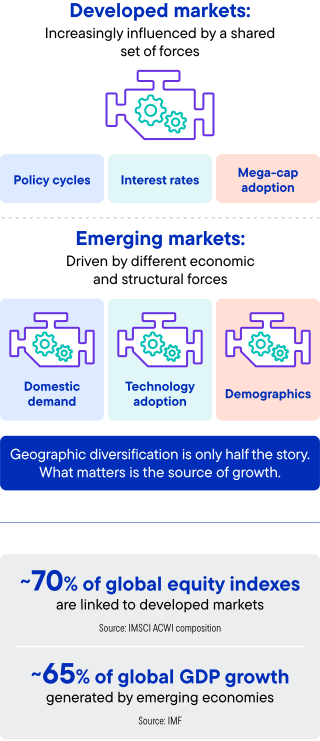
Indirect exposure to emerging markets through global strategies have historically been narrower than it appears. Global indices remain heavily weighted toward North America and other developed markets, both by market capitalization and by sector composition. Even where emerging markets are represented, exposure is often concentrated in a limited number of large index constituents, reducing the breadth of economic drivers that ultimately feed through to portfolio outcomes.
Emerging market equities offer diversification that operates on several levels at once—sector exposure is one. While North American markets are heavily influenced by a relatively concentrated group of large technology and platform companies, alongside financials and resource-linked industries, emerging markets provide access to a different part of the growth ecosystem. This includes technology hardware and semiconductors embedded deep in global supply chains, digital platforms tailored to local consumption, healthcare providers scaling access across large populations, and consumer businesses geared toward rapidly expanding middle-income demographics.
Economic drivers are another factor. Earnings growth in emerging markets is increasingly tied to domestic demand, innovation and productivity gains rather than external commodity cycles alone. That creates return streams that respond differently to shifts in interest rates, inflation dynamics and fiscal policy than those in developed markets. Over time, emerging market equities have exhibited meaningfully different return patterns from North American markets, reflecting distinct economic and earnings drivers.1
There is also a geographic dimension that is often overlooked. Emerging markets account for a growing share of global economic activity, consumption and capital investment. Yet their weight within global equity portfolios remains modest relative to that contribution. Exposure obtained indirectly through global funds can understate this reality, particularly during periods when developed-market leadership narrows.
What makes this relevant now isn’t simply the search for diversification, but the nature of diversification being sought. In an environment where developed-market equities are increasingly influenced by a common set of macro variables—monetary policy expectations, fiscal sustainability, and geopolitical alignment—return streams that are shaped by different structural forces become more valuable.
For portfolios built to perform across multiple regimes, emerging market equities have the potential to contribute diversification that is both structural and enduring. Not by replacing existing global exposures, but by complementing them in ways that broaden the opportunity set and reduce reliance on a single economic narrative.
Achieving that diversification in practice, however, requires discernment. The dispersion of returns across countries and companies can be wide, particularly during periods of stress, which reinforces the importance of active selection in identifying resilient businesses and managing specific country risks.
Endnotes:
- Calculations by Franklin Templeton’s Global Research Library with data sourced from MSCI, 5 Year Correlation as of 30 June 2025. Indexes are unmanaged and one cannot directly invest in them. Past performance is not an indicator or guarantee of future performance. Correlation measures the degree to which two investments move in tandem. Correlation will range between 1 (perfect positive correlation, where two items historically have moved in the same direction) and -1 (perfect negative correlation, where two items historically have moved in opposite directions). Diversification does not guarantee a profit or protect against a loss.
