
Skip to content

프랭클린템플턴 사칭 유의안내

최근 SNS를 통해 프랭클린템플턴을 사칭하여 코인 사기를 치는 사례가 발생하고 있습니다.
당사 및 임직원은 웹사이트, 전화, 이메일, 우편 및 소셜미디어(오픈톡, 리딩방 등)를 통해 투자상담이나 금융거래를 권유하지 않습니다.
투자자 여러분께서는 이러한 사이버 범죄 피해를 입지 않도록 각별히 주의하시기 바라며, 의심스러운 사항이나 문의사항이 있으시면 아래에 기재된 피해 신고 센터로 연락하시기 바랍니다

무등록 투자자문·일임업 관련
   금융감독원 유사투자자문 피해신고(유사투자자문업자의 경우)
1. 금감원 홈페이지(www.fss.or.kr) ➤ 「민원·신고」 ➤ 「불법금융신고센터」 ➤ 「유사투자자문피해신고」
2. 전화 신고: (02) 3415-7692, 7632, 7633

금융감독원 신고센터 전화 1332

경찰청 사이버범죄 신고시스템(ECRM) 또는 가까운 경찰서(112)
   링크 접속 (https://ecrm.police.go.kr/minwon/main) ➤ 「제보하기」

A performance story with deeper roots

Over the past year, emerging market equities have delivered strong returns, with the MSCI Emerging Markets Index posting gains of close to 30% over the period.1 That improvement has naturally drawn attention, particularly from investors who had grown cautious after a long stretch of uneven performance. It would be easy to dismiss this as a cyclical rebound or a short-term rotation. I think that would miss the bigger picture.

Equity markets (EM) are ultimately driven by earnings, and one of the more consistent features of emerging markets over time has been their ability to generate earnings growth above that of developed economies. Over the past 15 years, earnings growth has been the single largest contributor to emerging market equity returns, outweighing both valuation changes and currency effects.2

What has changed is the quality and durability of those earnings. The drivers today are less dependent on commodity cycles or external demand alone and increasingly anchored in domestic consumption, technology adoption, healthcare provision and financial inclusion.

We see this reflected in how EM markets have responded to recent global shocks. Inflation spikes, aggressive interest rate cycles and geopolitical stress have tested all asset classes. Yet many emerging economies entered this period with stronger balance sheets, more credible monetary frameworks and higher levels of foreign exchange reserves than in previous decades.3 The result has been greater resilience and, in several cases, faster recoveries.

For long-term allocators, that distinction matters. It suggests that recent performance isn’t an outlier but part of a broader structural story—one in which earnings growth, rather than multiple expansion alone, continues to do the heavy lifting.

A changing opportunity set

Perhaps the most underappreciated shift in emerging markets has been the transformation of their economic and market composition. Thirty years ago, EM exposure largely meant banks, energy companies and basic materials producers. Those sectors still matter, but they no longer define the opportunity set.

Emerging markets: Then vs Now
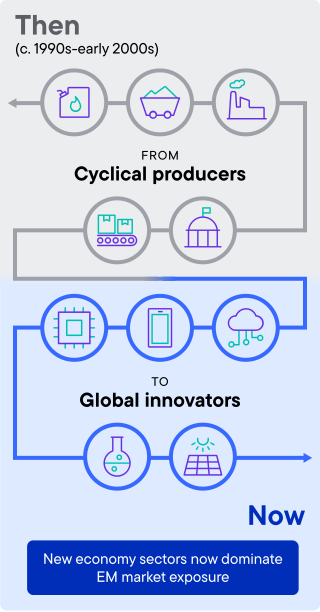
Today, emerging markets are home to many of the companies building the infrastructure of the modern global economy. Semiconductors manufactured in Taiwan and South Korea sit at the heart of digitalisation. Software engineers in India help global firms modernise their operations. Fintech platforms across Latin America and Southeast Asia are bringing millions of people into the formal financial system for the first time. Healthcare providers are scaling access and quality in rapidly ageing populations, while renewable energy developers are deploying capital at a pace that would have been unthinkable a decade ago.

When we look at market indices, this evolution is clear. “New economy” sectors—technology, communication services, healthcare and consumer-oriented businesses—now account for more than half of emerging market equity market capitalisation, while commodities represent less than 15%.4

That shift has materially altered the sources of earnings growth and the way EM equities behave across cycles. And it isn’t just a statistical shift either—it changes the nature of risk and return. Businesses built around intellectual property, platforms and networks have different margin profiles, capital intensity and growth trajectories than traditional cyclicals. Historically, they’ve benefitted disproportionately from scale, urbanisation and rising incomes—trends that remain firmly in place across much of the emerging world.

Innovation closer to home

One of the privileges of working in emerging markets is spending time with local teams who understand these changes from the inside. Over the past year, I have travelled to countries as different as Brazil and India. The contrasts are striking, but so are the common threads.

Brazil is a young, vibrant economy with a highly educated population and deep pools of entrepreneurial talent. India, for all its infrastructure challenges, continues to produce world-class engineers and technology businesses at remarkable speed. Today, emerging markets account for more than half of global patent grants, a share that has risen steadily over the past decade.5 That shift is being led in large part by North Asian companies in China and Korea, particularly in areas such as semiconductors, batteries and advanced manufacturing.

Innovation is no longer something imported into emerging markets—it’s increasingly home-grown.”

That matters for investors because it reshapes where future value is created. It also challenges the perception that emerging markets simply follow developed-world business models with a time lag. In many cases, companies are leapfrogging established approaches altogether.


IMPORTANT LEGAL INFORMATION

This material is intended to be of general interest only and should not be construed as individual investment advice or a recommendation or solicitation to buy, sell or hold any security or to adopt any investment strategy. It does not constitute legal or tax advice. This material may not be reproduced, distributed or published without prior written permission from Franklin Templeton.

The views expressed are those of the investment manager and the comments, opinions and analyses are rendered as at publication date and may change without notice. The underlying assumptions and these views are subject to change based on market and other conditions and may differ from other portfolio managers or of the firm as a whole. The information provided in this material is not intended as a complete analysis of every material fact regarding any country, region or market. There is no assurance that any prediction, projection or forecast on the economy, stock market, bond market or the economic trends of the markets will be realized. The value of investments and the income from them can go down as well as up and you may not get back the full amount that you invested. Past performance is not necessarily indicative nor a guarantee of future performance. All investments involve risks, including possible loss of principal.

Any research and analysis contained in this material has been procured by Franklin Templeton for its own purposes and may be acted upon in that connection and, as such, is provided to you incidentally. Data from third party sources may have been used in the preparation of this material and Franklin Templeton ("FT") has not independently verified, validated or audited such data.  Although information has been obtained from sources that Franklin Templeton believes to be reliable, no guarantee can be given as to its accuracy and such information may be incomplete or condensed and may be subject to change at any time without notice. The mention of any individual securities should neither constitute nor be construed as a recommendation to purchase, hold or sell any securities, and the information provided regarding such individual securities (if any) is not a sufficient basis upon which to make an investment decision. FT accepts no liability whatsoever for any loss arising from use of this information and reliance upon the comments, opinions and analyses in the material is at the sole discretion of the user.

Franklin Templeton has environmental, social and governance (ESG) capabilities; however, not all strategies or products for a strategy consider “ESG” as part of their investment process.

Products, services and information may not be available in all jurisdictions and are offered outside the U.S. by other FT affiliates and/or their distributors as local laws and regulation permits. Please consult your own financial professional or Franklin Templeton institutional contact for further information on availability of products and services in your jurisdiction.

Brazil: Issued by Franklin Templeton Investimentos (Brasil) Ltda., authorized to render investment management services by CVM per Declaratory Act n. 6.534, issued on October 1, 2001. Canada: Issued by Franklin Templeton Investments Corp., 200 King Street West, Suite 1400 Toronto, ON, M5H3T4, Fax: (416) 364-1163, (800) 387-0830, http://www.franklintempleton.ca. Offshore Americas: Outside the U.S., this publication is made available by Franklin Templeton, One Franklin Parkway, San Mateo, California 94403-1906. Tel: (800) 239-3894 (USA Toll-Free), (877) 389-0076 (Canada Toll-Free), and Fax: (727) 299-8736. U.S.: Issued by Franklin Templeton, One Franklin Parkway, San Mateo, California 94403-1906, (800) DIAL BEN/342-5236, franklintempleton.com. Investments are not FDIC insured; may lose value; and are not bank guaranteed. 

Issued in Europe by: Franklin Templeton International Services S.à r.l. – Supervised by the Commission de Surveillance du Secteur Financier - 8A, rue Albert Borschette, L-1246 Luxembourg. Tel: +352-46 66 67-1 Fax: +352 342080 9861. Poland: Issued by Templeton Asset Management (Poland) TFI S.A.; Rondo ONZ 1; 00-124 Warsaw. Saudi Arabia: Franklin Templeton Financial Company, Unit 209, Rubeen Plaza, Northern Ring Rd, Hittin District 13512, Riyadh, Saudi Arabia. Regulated by CMA. License no. 23265-22. Tel: +966-112542570. All investments entail risks including loss of principal investment amount. South Africa: Issued by Franklin Templeton Investments SA (PTY) Ltd, which is an authorised Financial Services Provider. Tel: +27 (21) 831 7400 Fax: +27 10 344 0686. Switzerland: Issued by Franklin Templeton Switzerland Ltd, Talstrasse 41, CH-8001 Zurich. United Arab Emirates: Issued by Franklin Templeton Investments (ME) Limited, authorized and regulated by the Dubai Financial Services Authority. Dubai office: Franklin Templeton, The Gate, East Wing, Level 2, Dubai International Financial Centre, P.O. Box 506613, Dubai, U.A.E. Tel: +9714-4284100 Fax: +9714-4284140. UK: Issued by Franklin Templeton Investment Management Limited (FTIML), registered office: Cannon Place, 78 Cannon Street, London EC4N 6HL. Tel: +44 (0)20 7073 8500. Authorized and regulated in the United Kingdom by the Financial Conduct Authority.

Australia: Issued by Franklin Templeton Australia Limited (ABN 76 004 835 849) (Australian Financial Services License Holder No. 240827), Level 47, 120 Collins Street, Melbourne, Victoria 3000. Hong Kong: Issued by Franklin Templeton Investments (Asia) Limited, 62/F, Two IFC, 8 Finance Street, Central, Hong Kong. Japan: Issued by Franklin Templeton Investments Japan Limited. Korea: Issued by Franklin Templeton Investment Advisors Korea Co., Ltd., 3rd fl., CCMM Building, 101 Yeouigongwon-ro, Yeongdeungpo-gu, Seoul, Korea 07241. Malaysia: Issued by Franklin Templeton Asset Management (Malaysia) Sdn. Bhd. & Franklin Templeton GSC Asset Management Sdn. Bhd. This document has not been reviewed by Securities Commission Malaysia. Singapore: Issued by Templeton Asset Management Ltd. Registration No. (UEN) 199205211E, 7 Temasek Boulevard, #26-03 Suntec Tower One, 038987, Singapore.

Please visit www.franklinresources.com to be directed to your local Franklin Templeton website.

CFA® and Chartered Financial Analyst® are trademarks owned by CFA Institute.

본 웹 사이트의 정보는 한국 거주자에 한하여 제공됩니다. 본 웹 사이트의 방문은 사용자가 한국의 거주자이며 또한 관련 관할권내 법규상 해당 정보에의 접근이 허용되어 있음을 스스로 확인하고 보장하는 것을 의미합니다. 본 웹 사이트는 당해 거주 국가의 법에 의해 본 사이트에 게시된 정보의 이용이 금지된 사용자를 위하여 제공되는 것이 아니며, 국내 법규와 상충하여 이용하여서는 아니 됩니다.

본 웹사이트에서 제공하는 정보는 특정 상품이나 서비스의 매입 또는 매도 제의나 권유를 위하여 운영되는 것이 아니며, 별도의 사전통지 없이 언제든지 수정될 수 있습니다. 본 자료는 사전 동의없이 가공 또는 제3자에게 유포, 출판, 복사 또는 배포될 수 없으며, 어떠한 투자결정도 본 사이트 정보에 의존하여서는 아니됩니다. 본 웹 사이트에서 언급되는 상품과 서비스는 관할권 내 적용 법규의 규제를 받으며 여타의 재판관할권에서는 유효하지 않을 수 있습니다. 따라서 본 웹 사이트 이용자는 스스로 그러한 규제를 숙지하고 준수하여야 합니다. 본 웹 사이트의 어떤 내용도 투자, 세금, 법률, 여타 전문 상담, 또는 특정한 사실 및 문제와 관련된 자문으로 해석되어서는 안 됩니다.

본 웹 사이트의 내용은 단지 정보의 제공을 목적으로 하고 있으며 고객의 특정 투자목적, 재정상태와 특정한 요구를 반영하고 있지 아니합니다. 프랭클린템플턴 펀드를 구입하고자 하는 경우 금융 관련 전문가와 상담하시기 바라며 전문가의 상담을 구하지 않을 경우, 펀드에 투자하시기 전에 선택한 펀드가 본인에게 적합한지 여부를 반드시 고려하시기 바랍니다. 과거 수익률이나 전망이 반드시 미래의 수익률을 의미하지 않습니다. 운용펀드의 가치와 수익은 상승하거나 하락할 수 있습니다. 펀드는 항상 투자 리스크를 수반하며, 운용 실적에 따라 원금의 손실이 발생할 수 있으며 그 결과는 투자자에게 귀속됩니다. 또한 외화표시 자산의 가치는 환율 변동에 따른 환차 손익이 발생할 수 있음을 유의하시기 바랍니다. 투자하시기 전 관련 투자 설명서 또는 간이투자설명서를 반드시 읽어 보시기 바라며, 투자설명서 또는 간이투자설명서는 해당 판매회사에서 확인하실 수 있습니다. 본 사이트의 정보는 해당 공표일 기준으로 가능한 정확한 자료라고 할 수 있으나, 프랭클린템플턴투자자문㈜은 구체적으로 표시된 것이나 암시된 것을 불문하고, 모든 제공된 자료의 정확성, 적정성, 또는 완결성을 보증하지는 아니합니다.

당사 웹 사이트에서 연결된 다른 웹사이트(또는 당사 웹사이트를 연결시켜 둔 다른 웹사이트) 내용에 대해 책임지지 않으며 타 웹사이트에서 제공하는 상품이나 서비스의 내용을 보장하지 않습니다. 타 웹사이트에서 대한민국 소비자 보호는 적용되지 않을 수도 있습니다. 다른 웹사이트를 사용 시에는 해당 사이트의 계약조건을 준수해야 합니다