

CONTRIBUTORS

Francis Gannon
Co-Chief Investment Officer, Managing Director, Royce Investment Partners
It is somewhat surprising that the one consistent question we have been hearing about today’s small-cap asset class centers around the effect private equity’s extraordinary growth has had on the number and quality of public small-cap companies.”
The most common question we are currently getting from investors about the small-cap asset class is not what you might think. Investors already know that small caps have underperformed their larger siblings over the past several years. They are also aware that small caps are cheap relative to large caps and are most likely working slowly out of an earnings recession that has plagued the asset class for the past two years. Investors also recognize the small-cap universe is full of innovative companies that are ripe for future growth and yet are significantly under-represented in most portfolios. Indeed, small caps continue to be characterized as the “forgotten” asset class. The Russell 2000 Index as a percentage of the Russell 3000 Index stands at 4.4%, the lowest we have seen since the 1980s. (The number has averaged around 8% going back to the small-cap index’s inception at the end of 1978.) Finally, many investors appear to agree with us that small caps are the original alternative asset class, one that tends to outperform following periods of high concentration among large-cap stocks in the broader market. So, it is somewhat surprising that the one consistent question we have been hearing about today’s small-cap asset class centers around the effect private equity’s extraordinary growth has had on the number and quality of public small-cap companies.
A familiar narrative has it that the extraordinary growth of private equity over the past decade has led companies to stay private longer, leading in turn to the belief that the number of smaller public companies is declining. In fact, our research shows that most of the decline in publicly traded small-cap companies occurred prior to 2012 and had more to do with the regulatory changes brought on with Sarbanes-Oxley than the growth in private equity. The number of companies has remained relatively constant other than the post-Covid spike in special-purpose acquisition companies.
Declining Number of Public Companies?
Number of Securities from 6/30/99 through 3/31/251
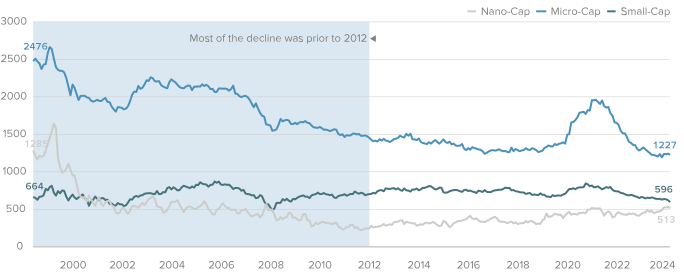
Excludes stocks with share price <US$1 and average daily trading volume < US$100,000. Nano-cap includes companies with market caps up to US$100 million. Micro-cap includes companies with market caps between US$100 million and US$1 billion. Small-cap includes companies with market caps between US$1 billion and US$3 Billion. Source: FactSet. Past performance is not necessarily indicative nor a guarantee of future performance.
As an active manager in the small-cap space, we think it is also worth pointing out that many of the thousands of companies owned by private equity are over-levered and lack earnings, all while purchase multiples have increased steadily over the years. To put that into perspective, of all the initial public offerings in the small-cap space since 2020, more than 70% of the companies had no earnings.1
Interestingly, if one thinks that a declining number of companies hurts returns, we would offer the Russell 1000 Growth Index as a counterpoint. At the end of 2019, the large-cap growth index consisted of 530 companies, a number that had fallen to 396 by the end of 2024. Over this same five-year period ending December 31, 2024,, the index had an average annual total return of 18.6%.
Lastly, small-cap companies have historically been acquisition targets for private equity or strategic buyers, a benevolent feature of listed companies known as the “takeout premium.” This is logical. Many small-cap companies, like the ones we favor in several of our strategies, are high quality, well managed businesses that during volatile periods trade at suppressed multiples—making them ideal targets for savvy long-term investors. This also underscores the often forgotten benefit of listed market investing: volatility is your friend, not your foe. What’s interesting about the current cycle is we’ve seen a few of our portfolio companies acquiring companies from private equity at significant discounts. In other words, public companies are currently becoming liquidity providers to private equity. Investors should ask themselves why this is happening and if it continues, what does it suggest about future private equity returns, deployment, and exit conditions within the private equity ecosystem?
We have long thought of small cap as an evergreen asset class, one that is consistently refreshed with new companies appearing as others mature or are acquired. This dynamic of constant renewal makes the asset class perpetually relevant, often inefficient, and usually ideal for active management. We therefore believe that the idea of companies staying private longer is truly a private equity issue—not a small-cap one. Companies may be staying private longer, but this does not mean that they will stay that way permanently as private equity investors demand a real return on their investment.
Stay tuned…
Definitions
The Sarbanes–Oxley Act of 2002 is a United States federal law that mandates certain practices in financial record keeping and reporting for corporations.
The Russell 2000 Index is an index of domestic small-cap stocks that measures the performance of the 2,000 smallest publicly traded US companies in the Russell 3000 Index.
The Russell 1000 Growth Index is an unmanaged index of those companies in the large-cap Russell 1000 Index chosen for their growth orientation.
Endnote
- Source: Bloomberg Finance, L.P. As of February 28, 2025.
WHAT ARE THE RISKS?
All investments involve risks, including possible loss of principal. Past performance is no guarantee of future results. Please note that an investor cannot invest directly in an index. Unmanaged index returns do not reflect any fees, expenses or sales charges.
Equity securities are subject to price fluctuation and possible loss of principal.
Commodities and currencies contain heightened risk that include market, political, regulatory, and natural conditions and may not be suitable for all investors.
Small- and mid-cap stocks involve greater risks and volatility than large-cap stocks.
Active management does not ensure gains or protect against market declines.
Any data and figures quoted in this article sourced from Russell Investments, FactSet, Bloomberg and Reuters.
Important data provider notices and terms available at www.franklintempletondatasources.com. All data is subject to change.
WF: 5438156
